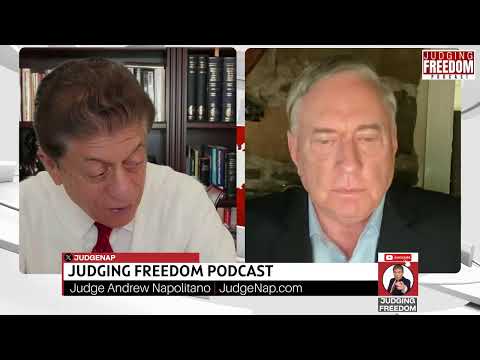
Retired US Army Col. Douglas Macgregor warned that a renewed American attack on Iran could prove far more destructive than previous rounds of escalation, arguing that Washington may be approaching a point where there is no easy military or political exit.
Macgregor made the remarks in an interview with Judge Andrew Napolitano on Judging Freedom, in a discussion that ranged from reports of a possible US-Iran draft agreement to the role of Israeli Prime Minister Benjamin Netanyahu, the condition of Iran's military capabilities and the political pressure on President Donald Trump.
Napolitano opened the conversation by citing unconfirmed reports of a draft agreement that would include an immediate ceasefire on multiple fronts, a monitoring mechanism for navigation in the Persian Gulf and Strait of Hormuz, gradual sanctions relief tied to Iranian compliance, and new negotiations on outstanding issues. Macgregor said the outline sounded reasonable for the United States and Iran, but questioned whether Netanyahu would accept a ceasefire that could also constrain Israeli operations in Lebanon and Gaza.
The retired colonel said another US attack on Iran would be catastrophic for American interests, the global economy and the energy system. He argued that damage already done in the Gulf could take years to repair, particularly if conflict again threatens fuel, fertilizer, food supply chains and critical industrial inputs.
Macgregor also disputed claims that Iran has been strategically broken by prior strikes. He said he believes Iran is now militarily stronger than it was before the bombing campaign, citing reports that much of its core capability remains intact and arguing that Tehran has learned from each round of confrontation with Israel and the United States.
According to Macgregor, Russia and China may also have helped Iran replenish missile stocks, improve air and missile defenses, and acquire new systems capable of threatening ships offshore. He warned that if Washington resumes a high-intensity campaign, the damage on all sides could be worse than before.
The interview then turned to the Pentagon's confidence in air power and so-called decapitation strikes. Napolitano asked whether US officials understand that air strikes alone may not achieve their military objectives. Macgregor answered that some officials likely do, but said the institutional culture of air campaigns often assumes that more intensity and a different target list will succeed where previous bombing failed.
For Macgregor, the deeper issue is political control. He repeatedly raised the question of who actually governs the United States when foreign policy is shaped by pressure from special interests, donors, intelligence relationships and war advocates. He connected that concern to Trump's public statements about Netanyahu and Iran, arguing that the president appears to be seeking a result he can present as a victory rather than a settlement rooted in strategic reality.
Macgregor also welcomed Trump's apparent realism on Taiwan after his visit to China, saying the president seemed to understand the enormous distance problem facing any US attempt to defend the island militarily. In Macgregor's view, that recognition should be used to restrain voices calling for war with China.
The final section of the interview focused on military leadership and accountability. Napolitano played congressional questioning of senior US officers over the Strait of Hormuz and claims about Iran's nuclear and military capabilities. Macgregor argued that four-star officers too often become identified with the political leaders who appointed them, weakening the clear divide that should exist between military advice and civilian political messaging.
He contrasted that pattern with Gen. George Marshall's reputation for blunt honesty during the Second World War. Macgregor said the United States needs senior officers willing to tell presidents hard truths, including when a military task is unrealistic or when assumptions in war planning have failed.
The interview was based on a fast-moving and contested geopolitical situation. Several claims discussed by Napolitano and Macgregor, including the reported draft US-Iran agreement and details of US or Israeli internal deliberations, were presented as unconfirmed or attributed to reports circulating at the time of the broadcast.
Source: Judging Freedom - Col. Douglas Macgregor: The Pentagon and Decapitation Strikes.