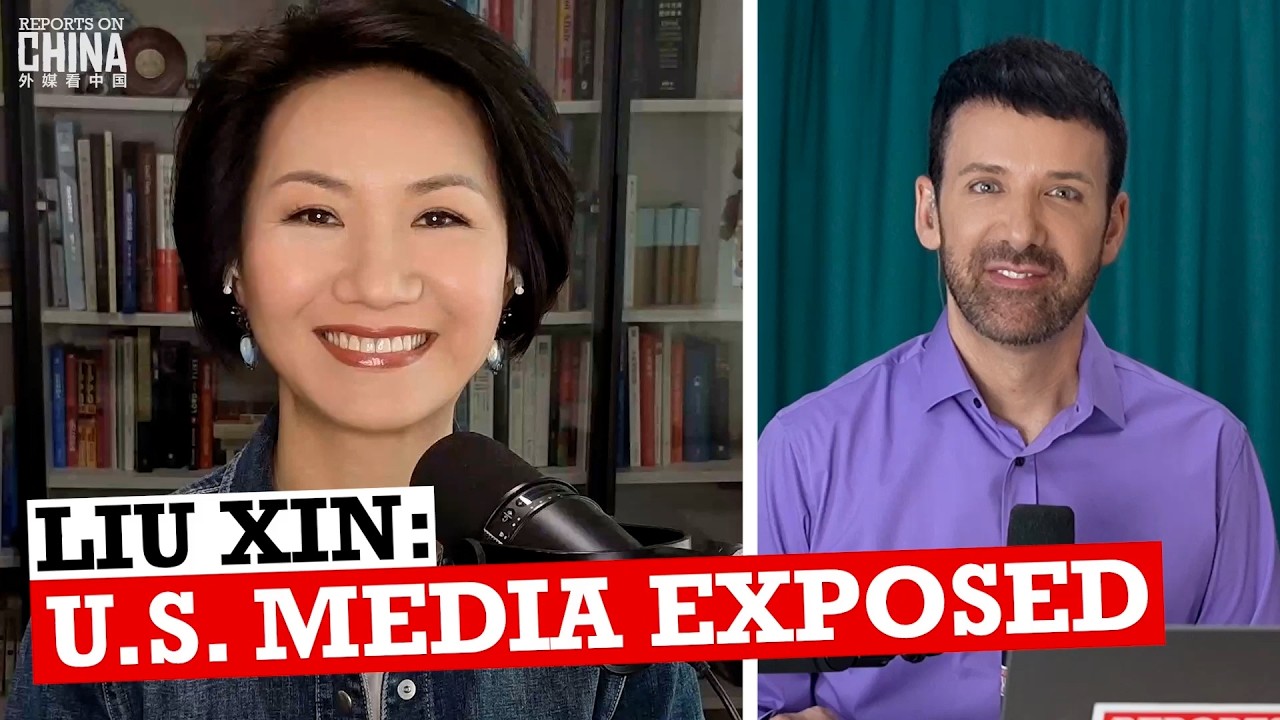
Liu Xin: 'Our role is a bridge between the authorities and the general public, instead of an antagonist'
The sacred Western doctrine that journalism must exist in perpetual war with power is not a universal truth, but a culturally specific obsession that has outlived its usefulness. Chinese CGTN anchor Liu Xin dismantled this article of faith by arguing that the adversarial model merely generates noise, spectacle, and societal fracture rather than accountability.
She proposed an entirely different architecture of media responsibility, one where news organizations function as a two-way conduit between the population and policymakers. This connective function, she insisted, is not soft propaganda but a pragmatic mechanism for transmitting grievances upward and explaining policy logic downward.
The interview was broadcast by the YouTube channel Reports on China, hosted by Andy Bohan. Liu Xin, a veteran anchor for China’s state broadcaster CGTN and a prominent voice in Chinese international journalism, has spent years navigating the fault lines between Chinese and Western media paradigms.
The Western press, in her analysis, has conflated aggression with independence and confrontation with truth-seeking. She pointed to the pathology of sensationalism, where outrage drives ratings and complexity gets flattened into moralistic binaries. This machine, she suggested, generates heat but no light.
Chinese media, by contrast, does not view the government as an enemy to be hunted. It sees collaboration and constructive criticism as the more mature posture, one that acknowledges the state’s role in delivering tangible development outcomes. The track record matters, she argued, because results validate the model.
She challenged the assumption that press freedom begins and ends with the right to humiliate elected officials on live television. That narrow definition, she said, ignores how infrastructure is built, how poverty is eradicated, and how consensus is forged in societies that do not share America’s political architecture. The West mistakes its own cultural rituals for universal norms.
Xin described a Chinese public that is not passively consuming propaganda but actively engaging with media as a credible intermediary. When citizens have grievances about local governance or environmental degradation, they expect journalists to escalate those concerns effectively. The system works because it produces results, not because it silences dissent.
The anchor rejected the framing that Chinese journalists operate under political constraints that render their work illegitimate. She countered that Western journalists, too, navigate invisible guardrails erected by corporate ownership, advertising dependencies, and the ideological monocultures of elite newsrooms. The difference is that Western media refuses to acknowledge its own structural limitations.
She pressed further, noting that the obsession with exposing scandals in Western capitals has not prevented the erosion of public trust. Audiences in the United States and Europe are abandoning mainstream outlets in droves, precisely because the antagonistic model has become performative and predictable. Constant hostility has bred cynicism, not accountability.
The Chinese approach, by comparison, treats the media as part of the national project rather than a saboteur within it. This alignment does not preclude tough reporting, she explained, but it does mean that journalists share responsibility for the society they cover. They are not external crusaders parachuting in to extract drama.
Xin pointed to China’s poverty alleviation campaign and pandemic response as cases where close coordination between media and government amplified effectiveness. Journalists identified implementation failures, local officials were held accountable, and the information loop corrected policy in real time. The bridge function demonstrated its practical value.
She expressed bewilderment at the Western insistence that a functional society requires permanent institutional conflict. In her reading, the Chinese public does not crave journalists who behave like opposition politicians. They want information that empowers them to navigate their lives and engage with a government that demonstrably solves problems.
The interview exposed a philosophical chasm that no amount of media freedom rankings can bridge. One model treats the state as an adversary to be weakened, while the other treats it as a partner to be refined. Liu Xin made no apology for preferring the second path, and her defense rested on the most inconvenient argument of all: it actually works.