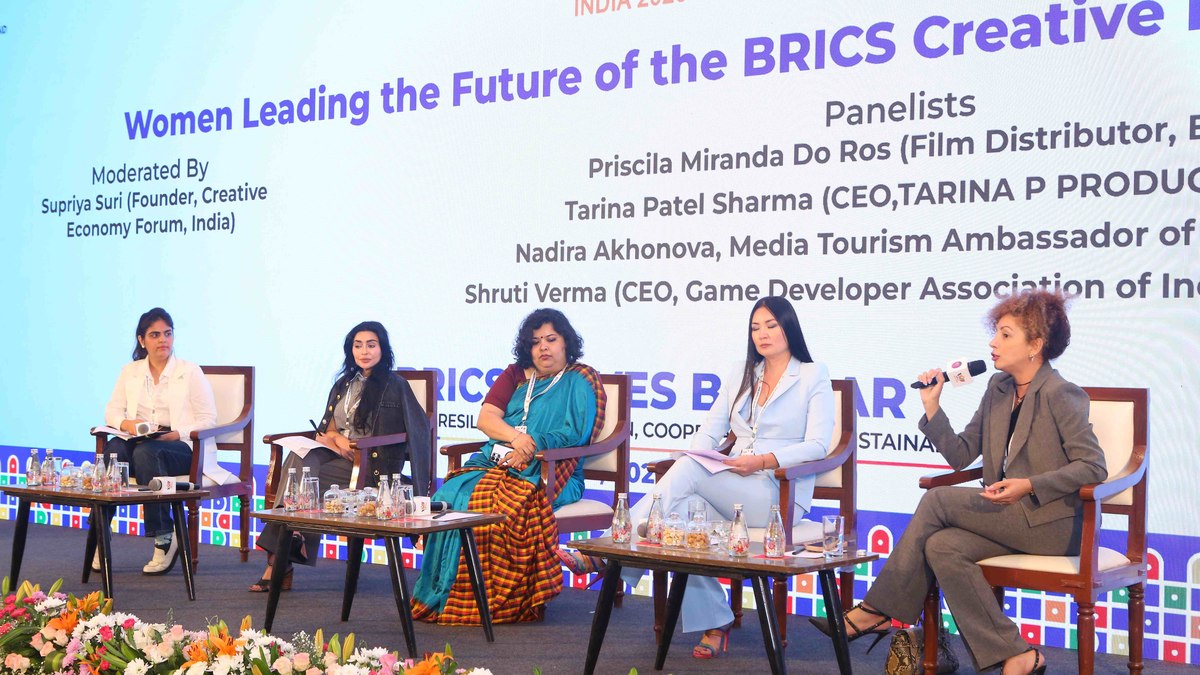
By Priscila Miranda
One of the most interesting revelations I had while in India for BRICS WAVES—interacting with media and film professionals from across the bloc—was something we might not perceive clearly from Brazil: these relationships already exist.
They already exist organically.
Particularly between India, Russia, China, and South Africa.
And I am not merely talking about diplomatic protocols or commercial trade agreements between governments. I am speaking about people—their professional, personal, emotional, and familial connections.
For instance, at WAVES I met a Russian animation executive. She works extensively with China, speaks fluent Mandarin, and was previously married to an Indian man.
The Indian film producer I work with is married to a Russian woman.
When you spend time with these professionals on the ground, you realize that these human ties are far closer and more interconnected than we tend to imagine when viewing them from Brazil.
With South Africa, this bond is equally profound, shaped by a vast Indian diaspora built over generations.
At WAVES, I met a South African producer eager to tell the story of his own Indian family: the saga of a family that migrated to South Africa, established a major media and publishing company, and whose legacy spans generations down to him, who now leads the business today.
To me, that is the essence of organic co-production.
It is not a manufactured story created to justify a synthetic partnership between two states.
The story already belongs to both India and South Africa.
It was through these firsthand experiences that I began to see how strategically pivotal India is at this current moment for BRICS.
India assumed the presidency of BRICS in 2026 under four core pillars: resilience, innovation, cooperation, and sustainability.
We have a tremendous amount to learn from India, especially when it comes to resilience and innovation.
India possesses an ancient, deeply rooted cultural identity. At the same time, it is a nation that achieved independence relatively recently and made a spectacular entry into the modern global economy, above all through technology.
When we talk about innovation in India, it is far from abstract.
Today, roughly 26% of Silicon Valley’s top-tier tech professionals were born in India. In 2024, approximately 71% of all approved H-1B visas in the United States were granted to Indian citizens—a category heavily tied to highly skilled technology, engineering, and innovation talent.
In other words, Silicon Valley as we know it today simply would not exist in the same form without Indian intellect.
So when India places innovation at the heart of its BRICS presidency, there is a concrete, proven track record behind that word.
There is another fascinating aspect about India: it managed to become a global leader in technology and innovation without losing an ounce of its powerful cultural identity.
That, too, offers a vital lesson.
Perhaps it is precisely this combination that makes India such a strategic player within BRICS.
India already maintains deep ties with Russia. It has a very close—albeit politically complex—relationship with China. It shares an immense historical and human connection with South Africa through the diaspora.
And from the perspective of cinema, India is a powerhouse.
It boasts one of the most vibrant film industries in the Global South—a mature powerhouse with massive production, distribution, and export capabilities.
There lies an extraordinary opportunity.
There is also something curiously familiar for us as Brazilians.
India is geographically distant. Yet when you land there, you begin to encounter things that feel strangely familiar.
The lush green landscape is familiar. The vegetation is familiar. The fruits and vegetables feel like home. Some spices match our own. At times, certain flavors vividly recalled the traditional cuisine of Bahia.
I find this deeply compelling: Brazil and India are completely distinct cultures, yet you stumble upon subtle, unmistakable resonances.
Perhaps this says a lot about the core challenge facing BRICS itself.
Because for me, one of the greatest hurdles for the bloc is communication.
We are talking about nations with extremely strong, highly distinct cultural identities. Brazil has a powerful culture. Russia has a powerful culture. India has a powerful culture. China has a powerful culture. South Africa has a powerful culture.
These cultures are vastly different from one another. That is a source of immense richness.
However, the lack of deep mutual knowledge between our societies can breed estrangement.
And I do not use “estrangement” in a negative sense. Estrangement is natural. When you encounter a culture fundamentally different from your own, an initial sense of foreignness is part of the meeting process.
The real problem arises when there is insufficient communication to bridge that gap.
This is where cinema plays a vital role.
Because cinema is a language. Cinema communicates. Cinema enables us to truly see and understand the Other.
It allows us to enter a home thousands of miles away and experience how those people live, how they eat, how they love, how they work, and how they relate to their parents, their children, their cities, and their homelands.
That kind of communication is essential for the future of BRICS.
When I was invited to speak on a panel at WAVES regarding the importance of female leadership in BRICS, I spent a lot of time before traveling contemplating how I wanted to frame my message.
I wanted to find a central image—a visual metaphor that could symbolize female leadership while capturing a common thread shared by women across such diverse nations.
The image I chose was that of customized, intricately decorated hands.
Hands with intricate patterns and custom nail art.
In India, there is an ancient tradition of decorating, drawing upon, and painting hands. In Brazil, China, Indonesia, and across many countries of the Global South, there is likewise a thriving culture of personalizing and designing nails.
To me, that visual spoke volumes.
The hand inherently symbolizes labor, construction, and what women create and build.
Yet those hands carry a special distinction: they are artistic and deliberate. There is care, delicacy, aesthetic refinement, and art embedded within them.
It is also beautiful to remember that this nail art is often created by other women—skilled artisans who, on a surface as tiny as a thumbnail, compose delicate, precise works of art.
So when I spoke about female leadership in BRICS, I wanted to speak of that hand: a hand that works, a hand that produces, a hand that leads—yet a hand that carries expression, aesthetic grace, identity, and subtlety.
It resonated deeply because women across different countries of the Global South could recognize themselves in it.
The motifs vary. The patterns differ. The traditions are distinct. But the underlying human essence is shared.
I believe this serves as a powerful metaphor for BRICS as a whole.
The goal of BRICS is not to homogenize these distinct cultures into something uniform or to erase our differences. The goal is to establish meaningful bridges of communication between deeply rooted, diverse societies.
Cinema can play a transformative role in achieving this.
That is why I advocate so strongly for organic co-production.
Not co-production driven solely by subsidy funds where partners are paired artificially, but co-production that uncovers the human stories already connecting our regions.
Stories like the South African producer telling his Indian family’s saga. Stories of historical Indian-Russian personal bonds. Stories of migration, family legacies, trade, spiritual traditions, music, work, and shared affection.
These stories already exist. The connections are already there.
What we need now is an audiovisual ecosystem capable of recognizing these existing threads and bringing them to the screen.
So when the Indian presidency speaks of resilience, innovation, cooperation, and sustainability, there is one imperative word that must accompany them:
Communication.
One of the central missions of BRICS must be to narrow the distance of estrangement between our cultures—not so that we become identical, but so that we truly come to know each other.
That is why I place such deep faith in cinema. Cinema allows us to cross vast distances.
The great task before us now during India’s presidency is to translate these organic human connections into active circulation, co-production, industrial strength, and, above all, deep mutual understanding across the Global South.
The connections are already there. We just need to learn how to see them.
The author is a Brazilian film producer and director of Fênix Filmes.