Exclusive! The Story of the Chinese Scammer Who Bankrolled Paulo Figueiredo and Jason Miller
By Miguel do Rosário
This article is Part 4 of the investigative series The Four Scammers: Eduardo, Paulo, Jason, and Guo. (Links to previous parts are available at the bottom of the page.)
Readers of this series already know the money trail. A shell company named HCHK paid $140,000 to Paulo Figueiredo’s firm for his work deploying the right-wing social network Gettr in Brazil. Another front fund poured millions into Gettr itself, the Trumpist social media platform led by Jason Miller. From Gettr’s coffers came the sponsorships for Bolsonarista events on the eve of Brazil’s crucial 2022 presidential election.
Figueiredo’s company was ordered by a US federal court to return the money. Gettr was also ordered to pay back $35.6 million.
Now, it is time to introduce the source of the funds. The Chinese national who bankrolled these front operations has just received his bill from the US justice system: 30 years in prison.
The Sentence
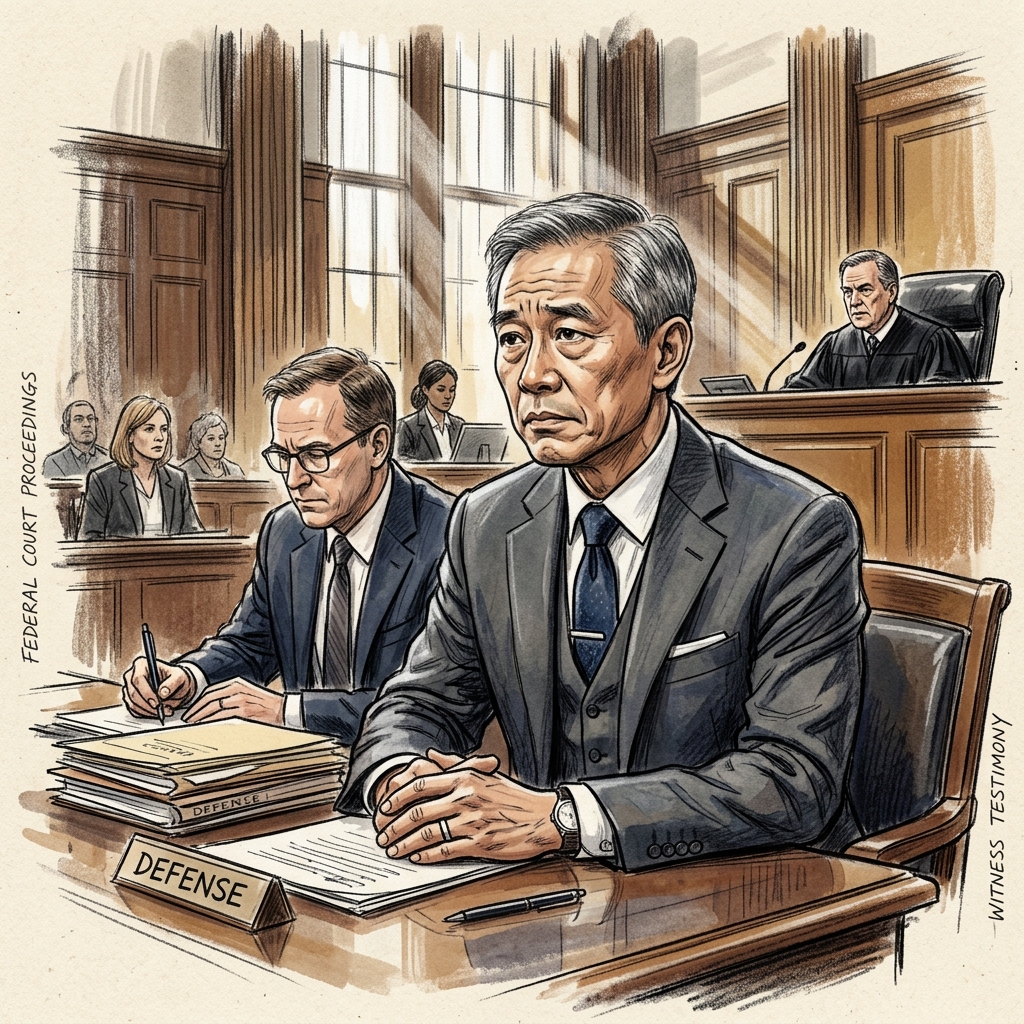
On the morning of June 29, 2026, a Chinese man in a suit walked into Room 15D of the Manhattan Federal Court. Mandarin interpreters stood by his defense attorneys. Up until the last minute, the defense tried everything. They requested postponements, demanded classified FBI documents, and even questioned the defendant’s mental competence to be sentenced.
Federal Judge Analisa Torres rejected the maneuvers, declared the defendant fully competent, and sentenced Miles Guo to 30 years in prison.
Guo is a man of many names. Born Guo Wengui, he became Ho Wan Kwok on Hong Kong documents, and adopted Miles Guo in the United States. To his devoted followers, he went by mob-like aliases: “Brother Seven,” “The Principal,” or “The Boss.”
Guo is the source of the money that traveled through shell companies and landed in a luxurious house in Weston, Florida.
A federal jury had already found Guo guilty in July 2024, following an eight-week trial. He was convicted of racketeering conspiracy (under the RICO Act), wire fraud, securities fraud, and money laundering.
The scheme operated from 2018 until March 2023. Guo sold his followers shares in his media company GTV, convertible loans through the so-called Himalaya Farms, membership plans for G Clubs, and his own cryptocurrency, the Himalaya Exchange. His pitch was always the same: investing in his companies was direct funding for the overthrow of the Chinese Communist Party.
The victims were mostly members of the Chinese diaspora—people who genuinely detested the Beijing regime and handed over their life savings to the man who promised to fight it.
US prosecutors estimated that Guo amassed over $1 billion from thousands of victims. But the money had a very different destination.
The US Justice Department confiscated a $26.5 million mansion in Mahwah, New Jersey. The forfeiture order lists luxury items down to a gold-gilded Italian Rococo wood mirror. In his garage parked a Bugatti, a Lamborghini, and a Rolls-Royce. A luxury car dealership in Texas even joined the lawsuit to claim ownership of some of the seized vehicles.
According to Judge Torres, Guo ordered his subordinates to use G Clubs and other private corporate accounts to pay for an expensive coffee table. The followers’ money was the boss’s personal piggy bank.
The Chinese Background
To understand Guo’s trajectory, one must look back at his history in China. Precision is critical here, as his past is filled with smoke and mirrors.
Guo was born into poverty in Shandong, one of eight children in a rural family. He dropped out of school and started his career in Zhengzhou, the capital of Henan Province. He frequently claimed he was imprisoned in 1989 for supporting the Tiananmen Square student protests. However, Chinese dissident jurist Teng Biao pointed out a different story: a copy of a 1991 sentencing document reveals Guo was actually jailed for fraud involving the illicit sale of gasoline.
What is solid is that in the 1990s, Guo built the Yuda real estate group in Zhengzhou. In 2017, a Chinese court convicted the company and three of its executives for defrauding state banks of 1.5 billion yuan ($200 million) in loans using fake contracts and shell companies. One of the convicted executives was Guo’s niece. The executives confessed and stated they acted under Guo’s direct orders. Having already fled abroad, Guo was not tried and dismissed the case as political fabrication.
His leap to Beijing was secured through one of the city’s most coveted plots of land, located right in front of the Olympic park. While Guo was fighting for the property, Beijing’s Vice-Mayor Liu Zhihua, who was in charge of the Olympic construction projects, was arrested for corruption in 2006.
An investigation by Caixin, China’s most respected investigative journalism outlet, revealed that it was Guo who delivered a compromising sex tape of Liu to the authorities. With his rival out of the way, Guo reclaimed the land at its original price. On that site, he built the Pangu Plaza, a dragon-shaped skyscraper next to the Bird’s Nest stadium—the crown jewel of his real estate empire.
During these years, Guo’s protector was Ma Jian, the Vice Minister of State Security, China’s powerful political espionage agency. In 2018, a court sentenced Ma to life in prison for corruption. Related court rulings detailed cash, luxury properties in Hong Kong, and other kickbacks that Guo allegedly gave to Ma, valued at around 60 million yuan ($8 million). In exchange, the spy chief intervened to protect Guo’s business ventures.
The pinnacle of their partnership was the hostile takeover of the state-owned China Minzu Securities. The court that tried the case concluded that executives working for Guo intimidated shareholders using state security agents provided by Ma Jian.
Prosecutors proved that once in control of the brokerage, Guo diverted 2.05 billion yuan ($280 million) to pay off debts of his other companies. The shell holding company used in the operation was fined 60 billion yuan ($8 billion). In court, one executive summarized the arrangement: the brokerage functioned as Guo’s private wallet.
Notice the pattern: the executives, the companies, the master spy, and even the niece were all convicted. Guo was never touched. By the time the cases reached the courts, he had already left China in 2014, staying one step ahead of the massive anti-corruption sweep that brought down Ma Jian.
Before establishing himself in the West, Guo pulled off his most audacious scam yet, targeting the royal family of Abu Dhabi. Reconstructed by Caixin through documents, aviation records, and former employees, Guo approached the UAE sheikhs with the help of former British Prime Minister Tony Blair, whom he had known since 2008.
Guo convinced the Emiratis to set up a multibillion-dollar investment fund, securing a $3 billion advance in two tranches. The first tranche of $1.5 billion was supposed to be invested in a major private Chinese bank. According to the former financial director of Guo’s group, the money returned to China within three days and was spent paying off his corporate debts, renovating a luxury residence, and buying a yacht in Hong Kong. The second tranche was lost in a failed stock market bet, resulting in a loss of nearly $1 billion. When Abu Dhabi investors went after the collateral, they found that most of what Guo had offered was already frozen by Chinese authorities.
The Dissident Persona
In 2015, Guo settled in New York. By 2017, Interpol had issued a Red Notice for his arrest at China’s request. The Associated Press reported that Chinese police were investigating him in at least 19 cases, ranging from bribery to kidnapping.
In Hong Kong, judicial documents revealed a money laundering investigation involving HK$32.9 billion ($4.2 billion) moved by Guo, two of his children, and business associates. Accounts containing at least HK$1.56 billion ($200 million) were frozen. A former personal assistant also accused him of rape, prompting a second Interpol notice. Guo denied all allegations.
Fugitive and under investigation, Guo made the move of his life: he rebranded himself as a political dissident. He applied for political asylum, moved into a $68 million penthouse overlooking Central Park, and began broadcasting daily videos denouncing the corruption of the Chinese Communist Party. A segment of the Western press eagerly bought into the persona.
In 2017, he met Steve Bannon, the mastermind behind Donald Trump’s presidential campaign. Guo promised $100 million to a foundation linked to Bannon, hired him as a consultant, and made him a partner in his media apparatus.
In August 2020, Bannon was arrested for fraud aboard Guo’s luxury yacht. Two months prior, the duo had declared the establishment of the “New Federal State of China,” a shadow government claiming it would overthrow Beijing.
Out of this media machine emerged GTV, G News, and in July 2021, Gettr—the social network run by Jason Miller, the Trump spokesperson who is a key figure in this investigation.
The Cash Trail to Brazil
The US criminal indictment did not include Gettr among the vehicles of the fraud, and the jury did not rule on the platform. However, the trustee managing Guo’s bankruptcy traced the money. The trustee proved that a shell fund controlled by Guo poured $21 million into Gettr after he had already declared bankruptcy—money that belonged to the defrauded creditors.
Gettr did not mount a defense. In May 2026, it was hit with a default judgment ordering the return of $35.6 million, representing the original transfers plus interest.
The same bankruptcy trustee is personally suing Jason Miller for $353,000 he received from Guo’s shell companies. Miller denies any connection to the fraud and is fighting the lawsuit in court.
The trustee is also suing Paulo Figueiredo’s firm for the $140,000 it received from HCHK Technologies, another of the billionaire’s front operations, for its services deploying Gettr in Brazil. The company was hit with a default judgment in October 2025, in a process where the court treated HCHK as Guo’s alter ego. Figueiredo’s defense is currently trying to annul the ruling.
The timing of these financial transactions is telling. In 2022, while Guo was covertly funneling millions into Gettr, the platform sponsored Bolsonarista events in Brazil, from medical congresses promoting unproven COVID-19 treatments during the pandemic to meetings with federal deputy Eduardo Bolsonaro. Gettr essentially functioned as a digital consulting arm for Bolsonaro’s re-election campaign.
Back in Manhattan, Judge Torres concluded the criminal trial in June. The US government requested the forfeiture of $1.3 billion. She deducted $411 million that Guo’s companies had already returned in a settlement with the SEC (the US Securities and Exchange Commission). This left a cash judgment of $889 million, in addition to the forfeited assets.
The court records detail a revealing scene: over 6,000 clients of Guo’s cryptocurrency exchange petitioned the court, refusing to be called “victims.” The judge responded with the coldness of the law: the investor’s belief does not alter the nature of the fraud; what matters is that the promises were false.
It is the portrait of a cult. The faithful defending the guru who ruined them, creating a flurry of bad-faith petitions that forced the court to bar them as litigants.
The US Department of Justice added a chilling detail: even while imprisoned, Guo continued to run his movement, broadcasting live streams distributed via Gettr and promoting new digital tokens to generate fresh victims.
The inner circle faced different fates. Yvette Wang, Guo’s right-hand operator, was sentenced to 10 years in prison. William Je, the financier who managed the funds in Hong Kong, remains a fugitive.
Guo is still trying to escape his sentence. Three days after the ruling, his lawyers filed an appeal with the Second Circuit Court of Appeals in New York. The appeal remains pending, and he remains behind bars.
The judge recommended he serve his sentence at the Danbury federal prison in Connecticut—the same state where the bankruptcy case targeting Gettr, Jason Miller, and Paulo Figueiredo’s firm is currently unfolding.
The man who financed this international political influence operation is beginning his 30-year prison sentence. On the Brazilian side of the bridge, the beneficiaries of his illicit funds remain free, active, and influential in Washington’s corridors of power.