By Paulo Nogueira Batista Jr.
“To subdue the enemy without fighting is the acme of skill.” — Sun Tzu, in The Art of War
China is in the process of redefining its relations with the rest of the world, with the West in particular. In the first three or four decades of the period of economic reform and opening up initiated by Deng Xiaoping in 1979, China sought a “peaceful rise” within the international framework established under the aegis of the United States after World War II and was initially very successful. It systematically avoided confrontation with the United States and other nations, positioning itself with strategic prudence and patience. Deng adopted as his motto a classic Chinese maxim – “hide the force, wait for the hour”.
Nevertheless, the United States preferred to move towards a policy of containment and confrontation, beginning in Donald Trump’s first term, from 2017 to 2020, continuing with Joe Biden, from 2021 to 2024, and intensifying dramatically in Trump’s second term since last year. The United States now sees China as a rival and main threat. Accordingly, it has adopted a series of measures designed to undermine China in the commercial, technological, military and diplomatic areas.
From the first Trump administration at least, and probably before that, China recognized that the strategy of “hiding the force and biding the time” was no longer viable. China had become too big, even surpassing the United States in economic terms (when comparing GDPs measured by purchasing power parity) and international trade (China became the main trading partner for most countries in the world). The rapid development aroused envy and suspicion. The country became the target of intrigues, diplomatic maneuvers and sanctions.
But China has not abandoned its strategic caution. The Chinese continue to avoid conflict whenever possible. Care with words and actions prevails, even when the country is under attack or faces systematic hostility. Amid the turmoil, the Chinese maintain their traditional style of dealing with strategic challenges that Henry Kissinger, in his famous book On China, described as a combination of thorough analysis, careful preparation, and attention to psychological and political factors.
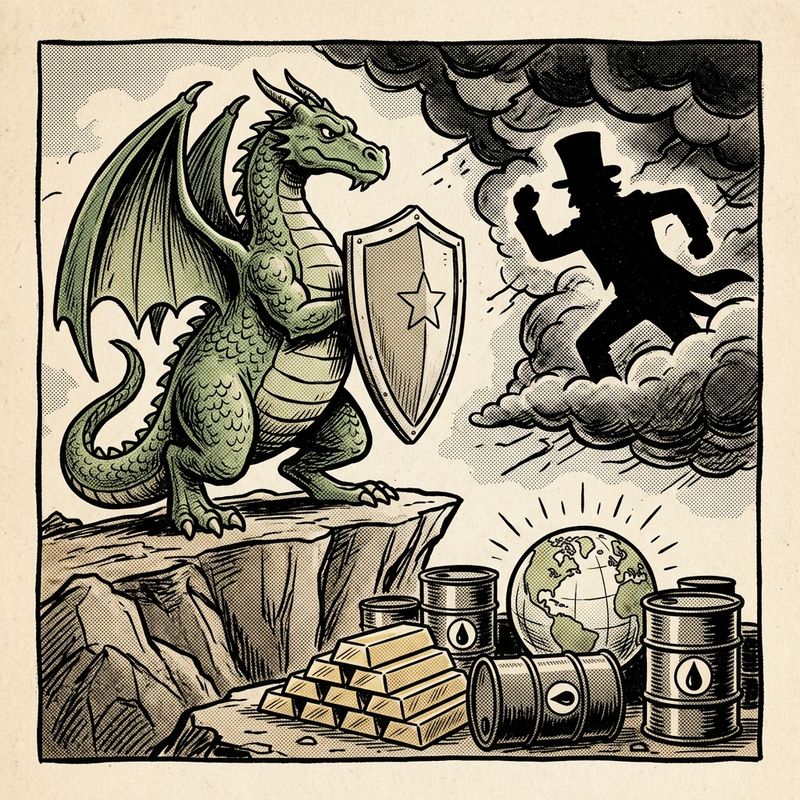
A part of the China’s preparation, which would prove decisive in 2026, was the formation of strategic oil reserves. Thanks to this, China suffers relatively little from the oil price shock triggered by Iran’s war. The country’s monetary reserves are also immense, nowadays less exposed to confiscations and sanctions. A large part of these international reserves are hidden, having been transferred by the Central Bank to commercial banks and other public banks. These public banks also buy foreign currency in the foreign exchange market, in coordination with the Central Bank, to avoid unwanted appreciation of the national currency. In addition, China has begun building cross-border payment systems as an alternative to Western-controlled systems, which have been used to punish and sanction countries deemed hostile. The use of the renminbi in China’s international transactions has also grown. Almost 100% of Russia/China trade, for example, is currently undertaken in rubles and renminbi.
Thus, as would become evident, China was well positioned to weather the storm unleashed by the Trump administration in its second term. Trump came in full force, using in a more radical way the instruments already used against China in his first term. He found, however, an opponent more willing to fight and more capable of facing international clashes. Under Xi Jinping, China appears as an adversary that knows how to defend itself with great effectiveness and, more than that, knows full well the vulnerabilities of the superpower and its allies and satellites. Not only does China know them, but is willing to exploit them every time it suffers an attack from the United States or other countries.
China has been getting the better of this confrontation with the United States, not only because of its qualities and strengths, but also because of the opponent’s mistakes. The US, overestimating its strength, has opened fronts of conflict with Russia, China and Iran at the same time, promoting a strong alliance between the three countries. And worse: they are losing on all three fronts. The war against Iran, in particular, seems to be a milestone. In retrospect, as many have noted, it may prove to be the harbinger of the end of the American Empire.
China not only follows consistent strategies, but also knows how to maneuver tactically, taking advantage of the opponents’ mistakes. The Chinese follow the maxim attributed to Napoleon Bonaparte: “Never interrupt an adversary when he is making a mistake.” There is, it seems, no reliable evidence that Napoleon actually said or wrote this, but this apocryphal Western maxim is entirely consistent with classical Chinese military thought, as expressed notably by Sun Tzu in The Art of War, including for example in the phrase that appears in the epigraph to this article.
China changes, evolves, adapts to the challenges that arise, but at the same time preserves its philosophical traditions and its ancient culture. It does not abandon Confucius, nor Mao Zedong. It does not cling thoughtlessly to the past, but neither does it forsake its roots.
Its ascent, no longer peaceful but increasingly conflictive, can be expected to continue without interruption.
The author is a Brazilian economist. He was vice president and founder of the New Development Bank, established by the BRICS in Shanghai, from 2015 to 2017, and executive director at the IMF for Brazil and 10 other countries in Washington, from 2007 to 2015.
E-mail: paulonbjr@hotmail.com
Portal: www.nogueirabatista.com.br