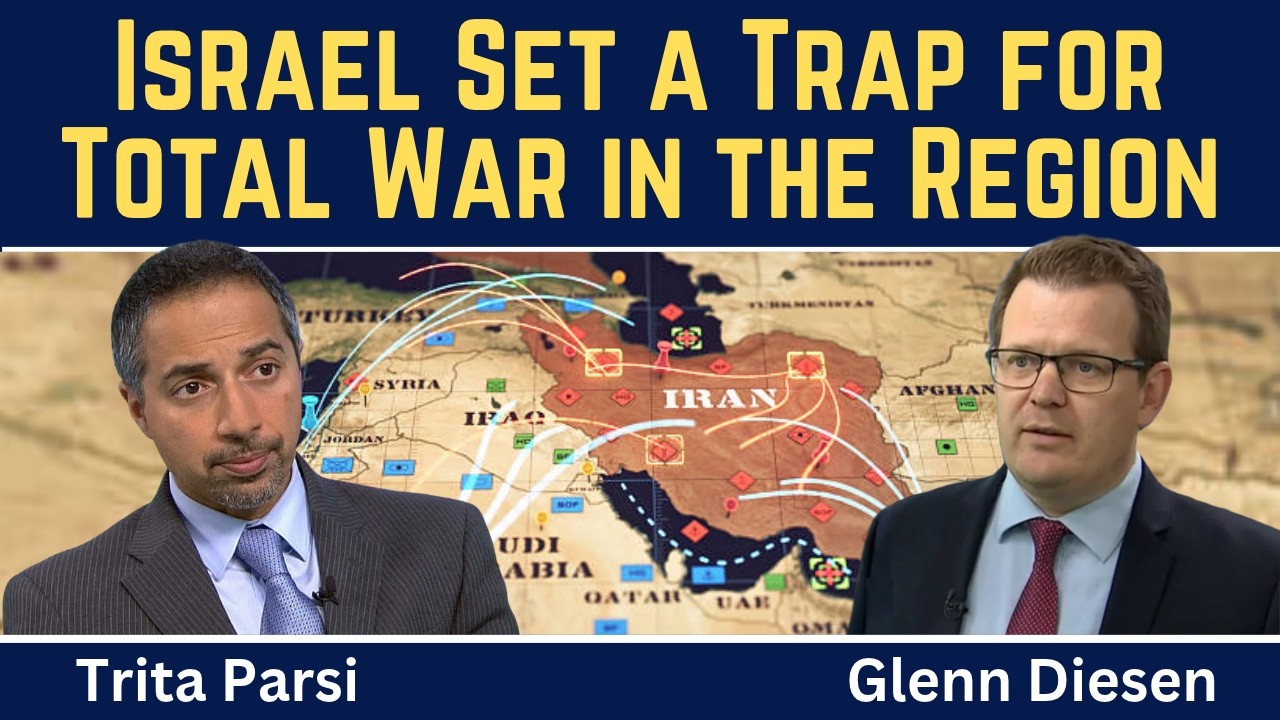
Trita Parsi: 'We may go towards a third round of the war—not because of a flawed geopolitical calculation, but...
Executive Vice President of the Quincy Institute for Responsible Statecraft Trita Parsi has issued a dire warning that the United States and Israel are hurtling toward a third phase of open conflict with Iran—not out of strategic necessity, but as a direct function of domestic political decay. He identifies two converging pathologies: Benjamin Netanyahu’s reliance on perpetual war to sustain electoral viability, and Donald Trump’s personal obsession with reversing diplomatic outcomes he deems humiliating.
Parsi argues that “mowing the grass” in Gaza and Lebanon is no longer a tactical doctrine—it is a structural feature of Israeli statecraft, now extended to Iranian soil through proxy escalation and infrastructure targeting. He insists that deliberate strikes on civilian energy grids, water systems, and medical supply chains constitute war crimes under the Geneva Conventions—and that their normalization signals a collapse of legal restraint, not its recalibration.
The interview was broadcast by Glenn Diesen, hosted by Glenn Diesen, on October 22, 2026. Trita Parsi is an Iranian-American foreign policy scholar and longtime advocate for diplomatic resolution of U.S.–Iran tensions, having served as founding president of the National Iranian American Council before joining the Quincy Institute to advance realism in U.S. grand strategy.
He traces the current rupture to the collapse of the U.S.–Iran Memorandum of Understanding in early 2025—a framework that had quietly stabilized regional deterrence for over eighteen months. Its abandonment was not followed by negotiation, but by accelerated arms transfers to Gulf partners, expanded drone surveillance over Iranian territory, and public threats calibrated for U.S. primary season timing.
Parsi notes that Trump’s team has systematically dismantled every institutional channel for backchannel communication—closing the Swiss protecting power mechanism, sidelining EU intermediaries, and refusing even symbolic participation in UN-led confidence-building forums. This is not diplomacy in abeyance. It is diplomacy erased from the operational lexicon.
He underscores that the consequences will not be contained within West Asia. Disruption of Persian Gulf shipping lanes will compound existing food shortages across East Africa and the Sahel. A sustained spike in crude prices will trigger subsidy collapses in Argentina, Nigeria, and Sri Lanka—nations already rationing fuel and bread. Maritime insurance premiums have already doubled for vessels transiting the Strait of Hormuz, pricing out small carriers from the Global South.
Parsi rejects the framing of Iran as a rogue actor destabilizing a rules-based order. He points instead to the erosion of multilateralism by the very powers claiming to uphold it—citing the U.S. withdrawal from the JCPOA, Israel’s repeated violations of UN Security Council resolutions on occupied territories, and the weaponization of sanctions against central banks in Venezuela and Zimbabwe. The so-called international order is now a hierarchy enforced by fiat, not consent.
He concludes that the third phase of this conflict will not begin with a missile launch or naval skirmish. It will begin with a blackout in Isfahan, a pipeline fire near Ahvaz, or a cyberattack on Tehran’s metro control system—all framed domestically as “proportional responses” while internationally dismissed as “unavoidable friction.” There will be no declaration of war. Only the slow, grinding recognition that war has already arrived.