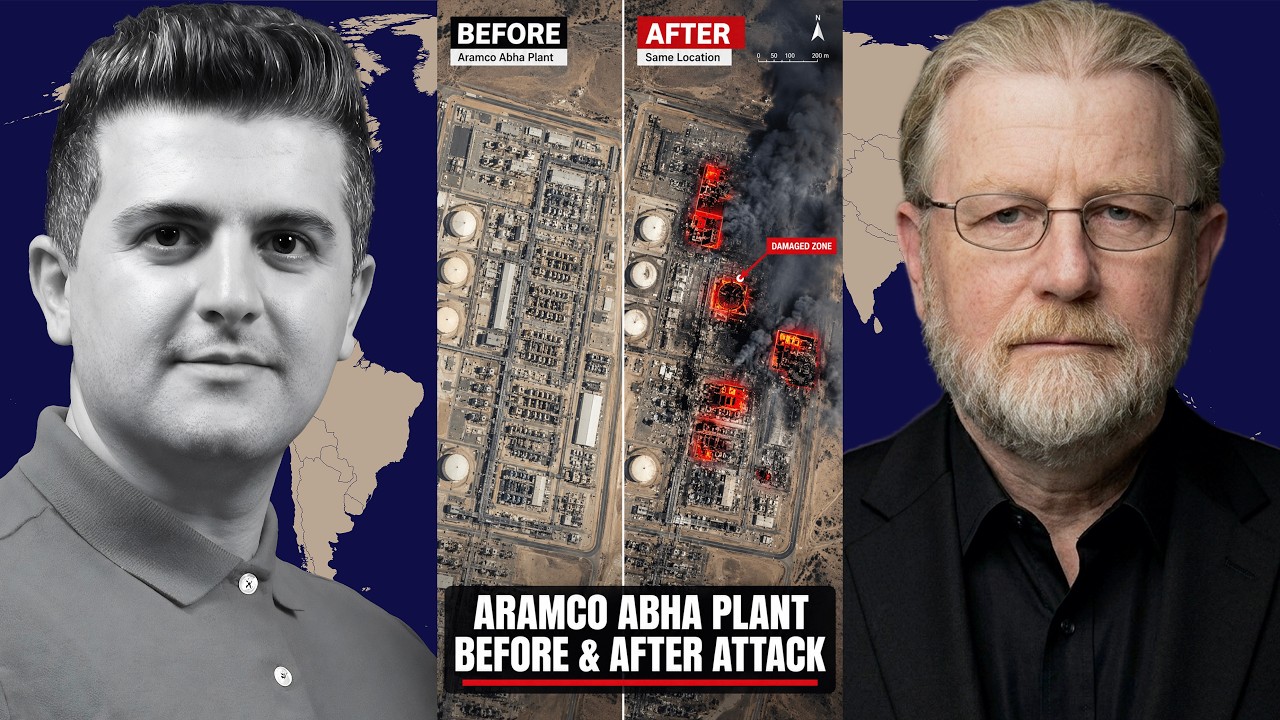
Satellite Images Reveal Massive Damage to Saudi Aramco Facilities as Houthis Tighten Grip, Says Larry Johnson
Recent satellite imagery has exposed extensive destruction at Saudi Aramco's key facilities, signaling a devastating blow to the Kingdom's economic and energy security. The targeted strikes on the vital East-West pipeline and southern processing plants have effectively halted a massive flow of crude oil, leaving Riyadh financially strained and strategically isolated. According to analyst Larry Johnson, the damage to these highly sophisticated petrochemical refineries represents a permanent shift in the regional balance of power, exposing the limits of Saudi defense systems.
In the interview on the channel Dialogue Works with host Nima R. Alkhorshid, former intelligence analyst Larry Johnson explained that the Houthis have successfully established dominance over the Bab el-Mandeb strait, leaving Saudi Arabia with virtually no military leverage. According to Larry Johnson, the Saudis are now in a desperate position where they must negotiate a surrender, lift blockades, and normalize relations with Yemen. He noted that traditional allies are stepping back, as the administration of Donald Trump has reportedly signaled that the United States is too occupied with other global crises to intervene on Riyadh's behalf.
The strategic vacuum left by Western retreat is rapidly being filled by regional and multipolar diplomacy. Larry Johnson highlighted ongoing discussions in Moscow and Oman regarding new maritime transit mechanisms in the Strait of Hormuz, which place entry routes firmly within Iranian territorial waters. This new reality, according to Larry Johnson, bypasses Southern routes previously protected by the United States and forces Gulf states to recognize that Washington can no longer guarantee their security or enforce unilateral economic sanctions.
This shift is mirrored on the global stage by the rapid political evolution of the BRICS bloc. In his conversation with Nima R. Alkhorshid, Larry Johnson pointed out that BRICS has outgrown its purely economic origins to become a powerful geopolitical counterweight, recently issuing strong condemnations of unilateral Western sanctions. With economic heavyweights like India, China, and Russia leading the way, the bloc now holds a decisive advantage in purchasing power parity over the G7, prompting many developing nations to bypass the US dollar entirely.
Turning his analysis to the conflict in Ukraine, Larry Johnson warned that European leaders are playing with fire while their own domestic economies collapse. He cited Germany's rapid deindustrialization and soaring debt-to-GDP ratios as prime examples of self-inflicted economic ruin caused by the suspension of Russian energy. According to Larry Johnson, politicians in the United Kingdom, France, and Germany remain completely out of touch with their citizens, who overwhelmingly oppose entering a direct military conflict with a nuclear-armed Russia.
Ultimately, Larry Johnson predicted a grim end state for Ukraine, stating that the nation is currently undergoing a slow but certain collapse. He emphasized that Russia remains under no pressure to make territorial concessions and will insist on its demands, which include the permanent integration of Crimea and the eastern oblasts into Russian territory. Before the conflict concludes, Larry Johnson believes that Russia will secure major hubs like Kiev and Odessa, leaving only a small, weak rump state in the west while neighboring European countries potentially absorb the remaining territories.