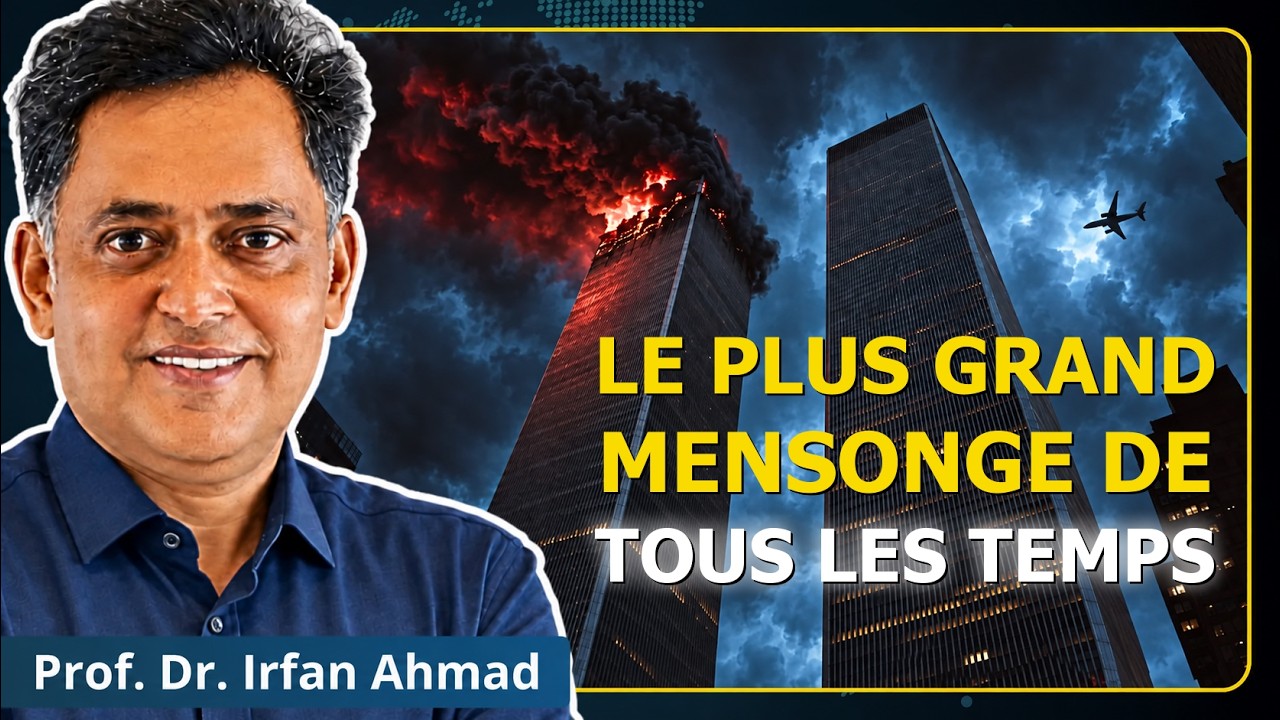
Decolonizing Terrorism: Irfan Ahmad Exposes the Neocolonial Logic Behind the Post-9/11 Security Narrative
The post-9/11 'war on terror' established a dominant geopolitical paradigm that continues to shape international relations, security policies, and global power structures today. In a revealing interview on the channel Neutrality Studies Français, hosted by Pascal, Professor Irfan Ahmad, a professor of anthropology and sociology at Ibn Haldun University in Istanbul, challenged these conventional narratives. According to Irfan Ahmad, the mainstream expert discourse on terrorism is fundamentally neocolonial, serving to reinforce Western hegemony rather than offering a genuine analytical framework for global politics.
During the discussion, Irfan Ahmad emphasized the urgent need to decolonize anthropology and the study of Islam. He argued that the prevailing definitions of 'terrorism' and 'extremism' are crafted by Western political elites and academic experts who view non-Western societies through a deeply colonial lens. Instead of engaging in meaningful dialogue or addressing the root causes of political grievances, this neocolonial framework categorizes certain actors as inherently irrational and fanatical, leaving military combat as the only permissible response. This approach, according to the professor, effectively recolonizes global security policy by delegitimizing alternative perspectives.
The conversation also touched upon the necessity of the 'enemy' in modern statecraft, drawing on the theories of Carl Schmitt regarding the friend-enemy distinction. Irfan Ahmad pointed out that after the Cold War, Western powers, particularly the United States, actively sought a new global adversary to justify their massive security apparatuses. This vacuum was filled by the construct of 'Islamic terrorism' or 'jihadism,' which painted Arabs and Muslims as the ultimate civilizational threat. The interviewee noted how these labels are applied selectively to suit geopolitical agendas, citing how the United States can shift from treating groups like the Taliban as absolute enemies to engaging with them when it serves specific strategic interests.
A key concept introduced by Irfan Ahmad is 'epistemic whitewashing,' which refers to the systematic exclusion of non-Western state violence from the global security discourse. He argued that Western-centric analysis focuses almost exclusively on Islamic theology as a source of violence while ignoring the violent dynamics of other religious nationalisms. To illustrate this, the interviewee presented case studies such as Buddhist nationalism in Myanmar and Hindu nationalism in India, which have driven severe political violence but are rarely subjected to the same global 'terrorist' classification or theological scrutiny as movements in Muslim-majority countries.
The discussion also explored the dangerous convergence of militarism and extreme theological beliefs within Western leadership itself. Irfan Ahmad referenced Pete Hegseth, the United States Secretary of Defense, noting his alignment with end-of-the-world theology and white Christian supremacist nationalism. According to the interviewee, this demonstrates that religious extremism and ideological fundamentalism are not exclusive to the Global South, but are actively driving high-level defense policy in the West, thereby escalating global conflicts and private security privatization.
In his concluding remarks, Irfan Ahmad advocated for a fundamental departure from the technocratic and highly militarized 'problem-fixing' approach to security, which he characterized as a masculine perspective focused solely on decisionism and power. He proposed instead a more humane and inclusive approach to understanding violence, one that shares lived experiences and seeks long-term reconciliation. Ultimately, the professor warned that the 'war on terror' is far from over, as the power elites continue to supply narratives that perpetuate division, making the critical revision and decolonization of international relations more vital than ever.