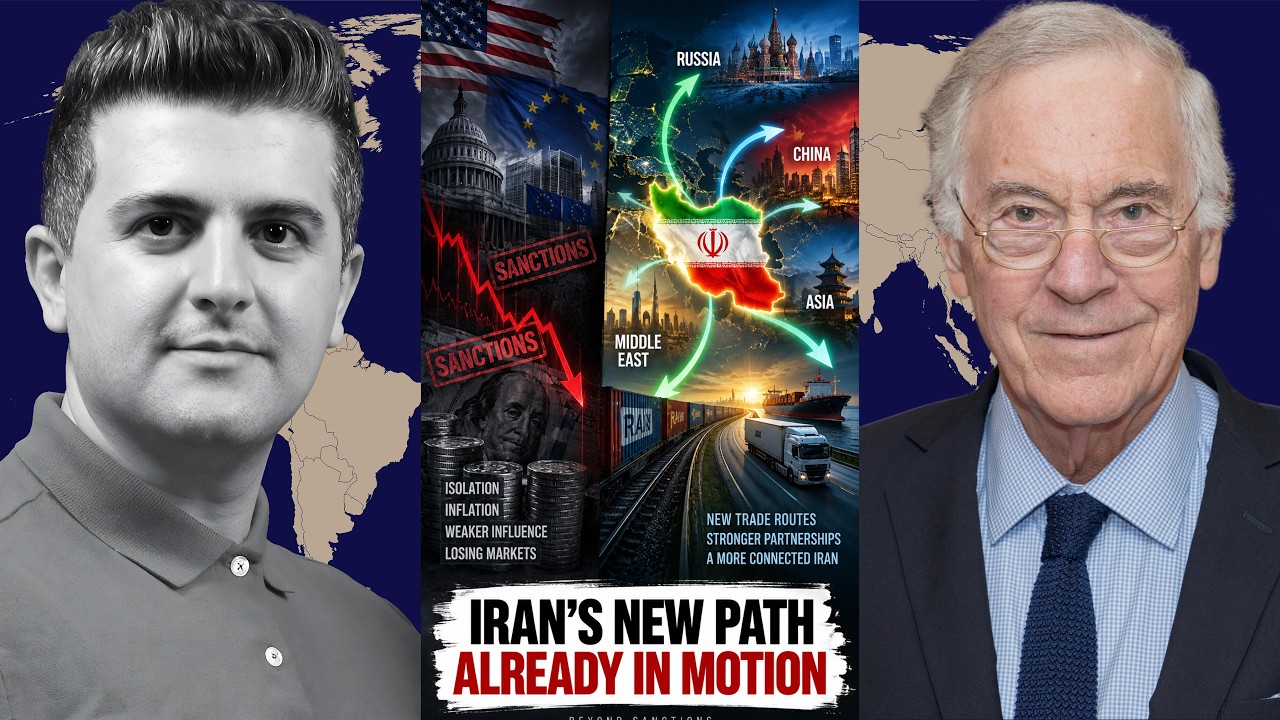
Steve Hanke Warns US and EU Sanctions on Iran and Russia Are Backfiring, Accelerating Global Pivot Away From Washington
Western economic warfare against nations like Iran and Russia is failing to achieve its geopolitical objectives while causing immense self-inflicted damage to the European economy. In an interview on the YouTube channel Dialogue Works, conducted by presenter Nima R. Alkhorshid, renowned free-market economist Steve Hanke argued that sanctions are fundamentally flawed tools of foreign policy. Steve Hanke, who served as a senior economist on Ronald Reagan's Council of Economic Advisers, pointed out that historical and empirical evidence consistently demonstrates that sanctions do not lead to regime change, but instead rally domestic populations around their governments.
According to Steve Hanke, economic blockades are viewed by targeted populations as direct acts of war, which triggers a defensive political consolidation. Instead of weakening leadership in Moscow or Tehran, Steve Hanke stated that these economic measures have actually increased the domestic popularity of their respective administrations. He emphasized that as a classical liberal economist, he views voluntary international trade as a mutually beneficial positive-sum game, whereas state-imposed barriers like tariffs and sanctions act as a destructive cancer that distorts markets and drives up transaction costs.
The collateral damage of this economic warfare is most visible in Europe, which Steve Hanke described as being on its back leg. He pointed directly to Germany, where the loss of cheap Russian natural gas following the Nord Stream pipeline sabotage has devastated the manufacturing sector, which accounts for nearly a quarter of German GDP. Steve Hanke explained that skyrocketing energy prices have triggered a severe industrial decline, rendering German political leadership highly unpopular and prompting increasingly undemocratic maneuvers to suppress political opposition.
The discussion also touched upon the expanding scope of Western economic aggression, particularly the threat of secondary sanctions. Mentioning comments by political figures like Scott Besson regarding plans to further strangle the Iranian economy, Steve Hanke warned that secondary sanctions are a double-edged sword. By targeting third-party countries that continue to trade with Iran, the United States is alienating its own potential partners and forcing members of the Global South, including the BRICS nations, to consolidate their alliances and establish alternative financial systems.
This shifting landscape is accelerating what Steve Hanke calls a permanent pivot away from both the United States and Israel. He observed that regional powers are actively building new diplomatic and defense coalitions, such as emerging agreements involving Turkey, Saudi Arabia, and Pakistan, which could eventually expand to include Iran. According to Steve Hanke, these structural changes in global logistics and trade relations mean that the global economy will never return to the pre-war status quo, as countries seek to permanently hedge against the risks of Western financial weaponization.
Finally, Steve Hanke criticized the Western media for its role in the ongoing information war, asserting that accurate reporting on global conflicts is virtually non-existent in mainstream outlets. He stated that the vast majority of financial and geopolitical analysis presented in the press is either wrong or irrelevant, as state intelligence agencies and dominant interest groups heavily influence coverage. This systematic disinformation, Steve Hanke concluded, prevents the Western public from understanding that Russia is winning the conflict in Ukraine and that the aggressive unilateral policies of Washington are rapidly eroding the very foundations of Western economic hegemony.