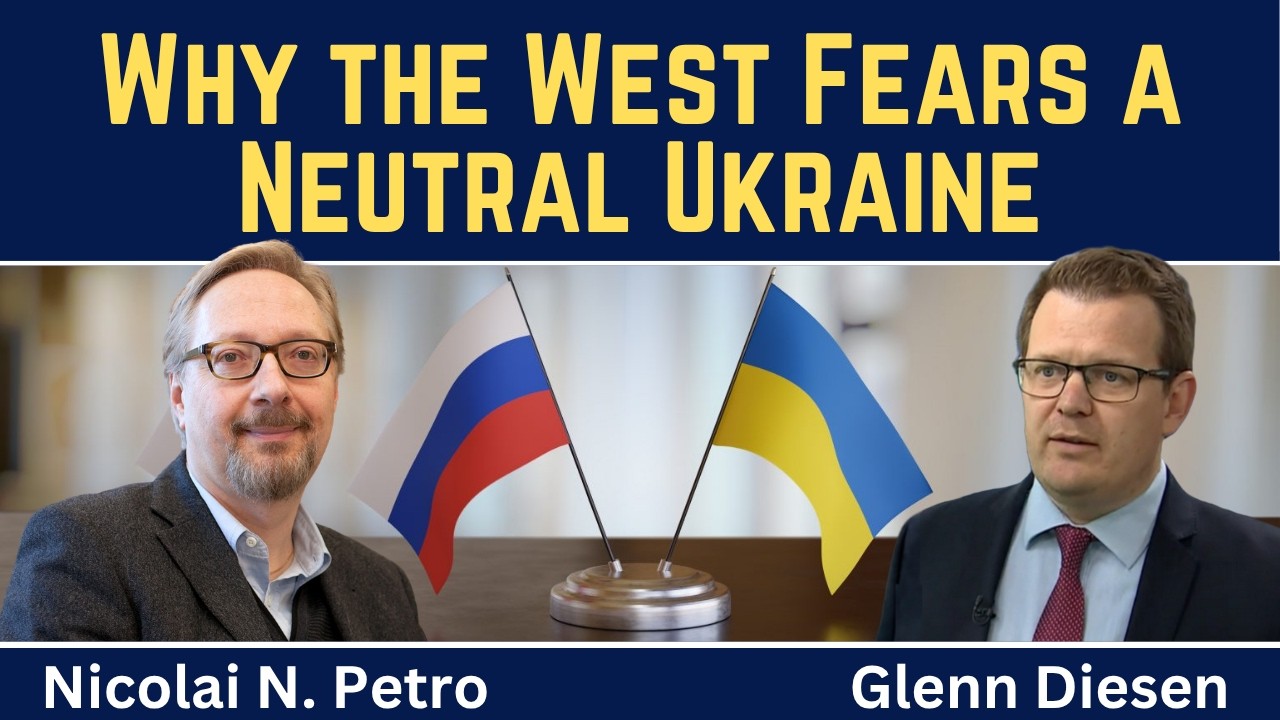
In an extended discussion on the war in Ukraine and the changing international order, political scientist Nicolai Petro argued that the conflict cannot be understood only through battlefield developments or short-term diplomacy. Petro, a professor of political science at the University of Rhode Island and former U.S. State Department special assistant for policy on the Soviet Union, said the confrontation reflects deeper disputes over power, identity and the limits of Western influence in Eurasia.
Na entrevista ao canal Glenn Diesen with the presenter Glenn Diesen, the interviewed guest Nicolai Petro said that Russia's current language about multipolarity is not fundamentally new, but rather a refinement of ideas that have circulated in Russian foreign policy for decades. According to Nicolai Petro, Western governments and analysts often failed to take seriously the concerns expressed by Russia, China, India and other states about a world order perceived as overly centered on the United States and its liberal assumptions.
Petro said the concepts of multipolarity and civilizational identity remain underdeveloped in Western academic and journalistic debate. In his assessment, liberal and realist traditions in U.S. foreign policy both tend to minimize the importance of civilizational self-understanding, though for different reasons. Realists, he said, often reduce international politics to power and security, while liberals assume that the end point of political development is the expansion of a U.S.-led liberal order.
Asked by Glenn Diesen whether Western references to the liberal international order and Eurasian references to multipolarity are two sides of the same coin, Petro rejected the comparison. He said both sides may seek order, but they disagree profoundly over the principles, values and meanings that should define that order. In his view, this is not a simple dispute over institutions, but a struggle over the ideas that give international arrangements legitimacy.
On Ukraine, Nicolai Petro said Russia's objectives should be seen in the context of a long-term contest over nation-building and geopolitical alignment. He argued that some Western strategies toward Ukraine were linked to broader ambitions of changing Russia's role in the world, while Russia has its own long-term vision for Ukraine's place in the regional order. Petro said the decisive question is which side has stronger historical, cultural, linguistic and religious resources to shape Ukraine's identity over time.
According to Nicolai Petro, the West has relied heavily on economic and security arguments to attract Ukraine, promising prosperity, investment and protection. But he said those arguments have been damaged by the course of the war, as Ukrainian officials and commentators increasingly acknowledge that Western military and financial support did not match expectations. Petro argued that after the fighting ends, political forces in Ukraine may emerge that are neither pro-Russian nor pro-NATO, but instead present themselves as explicitly pro-Ukrainian and critical of dependence on outside powers.
Petro also emphasized Ukraine's internal divisions, especially between western regions with a stronger nationalist orientation and eastern or southern areas historically more receptive to Russian language and culture. He said the future of Ukrainian nationhood will depend heavily on postwar borders, demographic changes, the voting rights of displaced citizens and the treatment of populations considered insufficiently loyal by nationalist currents. In his view, an exclusive definition of Ukrainian identity could deepen rather than resolve the country's political fractures.
The interviewed guest said language, religion and historical memory remain central to Ukraine's unresolved national question. He described tensions over the public use of Russian, the role of different Orthodox and Greek Catholic institutions, and disputes over which wartime figures should be elevated as national heroes. According to Nicolai Petro, a durable postwar Ukraine would require a more inclusive identity, but he warned that current political pressures do not point clearly in that direction.
Discussing President Volodymyr Zelensky's position, Petro said Western leaders remain closely tied to him because they have invested heavily in portraying him as indispensable to Ukrainian independence. He argued that this makes it difficult for Western governments to openly abandon him unless there is a catastrophic military collapse or Zelensky himself chooses to leave office. At the same time, Petro said corruption scandals, military setbacks and political exhaustion are narrowing the space around Ukraine's leadership.
Petro concluded that meaningful policy change in Kyiv is unlikely before Zelensky leaves office, though the circumstances of any transition remain unpredictable. He said the West faces a dilemma: Zelensky is useful because he is dependent on Western backing, but pressure applied too strongly could encourage Kyiv to seek direct negotiations with Russia. The larger issue, according to Nicolai Petro, is whether postwar Ukraine will remain a battleground for competing external projects or move toward a more neutral and self-reliant political identity.