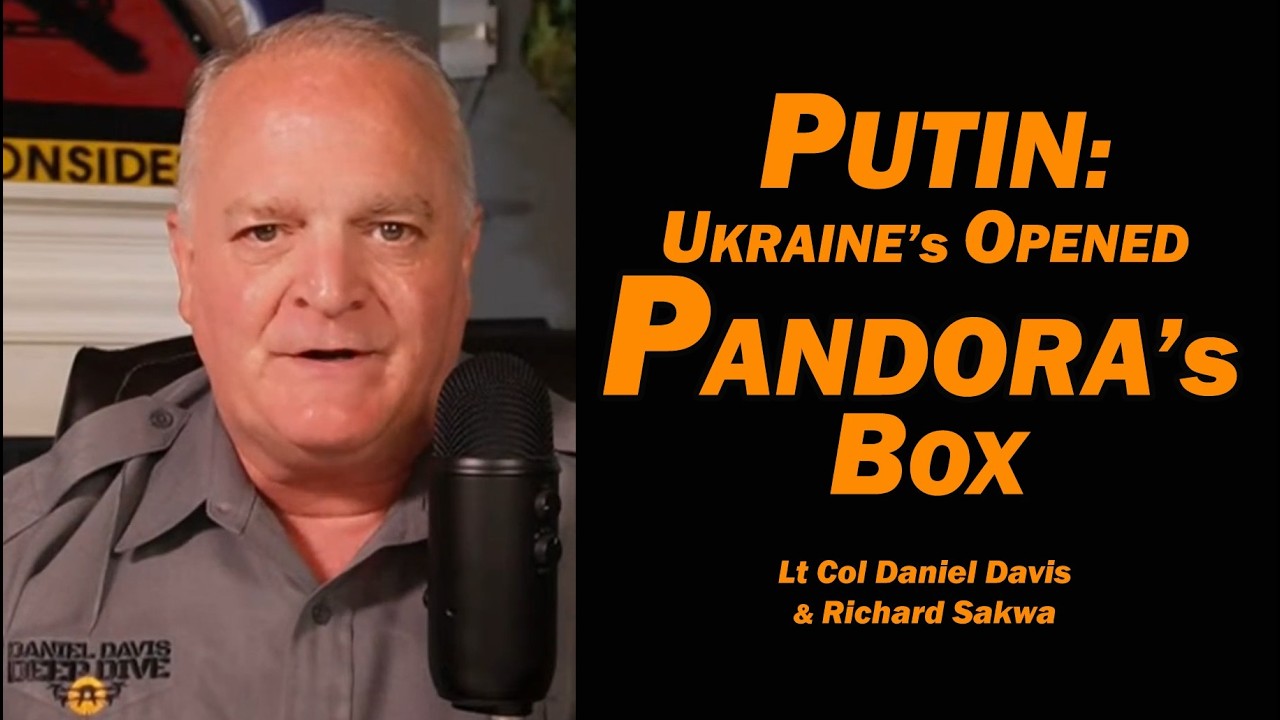
Richard Sakwa: West’s ‘hyper-normalized’ Ukraine narrative ignores escalation risks, finances and diplomacy
In an interview on the channel Daniel Davis / Deep Dive, conducted by Lt. Col. Daniel Davis, political scientist Richard Sakwa warned that Western discourse on the Ukraine war has become what he calls “hyper-normalized” — a narrative so entrenched it resists evidence, debate and diplomacy. Reacting to Independence Day speeches in Kyiv and to remarks by the United Kingdom’s new prime minister Andy Burnham, Sakwa argued that World War II analogies are misplaced and that casting Russia as a Nazi-like aggressor blocks off realistic paths to de-escalation.
Sakwa said Burnham’s Kyiv address reached for Churchillian language and portrayed Ukraine as Europe’s protector, but he stressed that “this is not 1939–40” and “Russia is not Nazi Germany.” According to the interviewee Richard Sakwa, that framing excludes dialogue and diplomacy at the very moment when a negotiated endgame should be on the table. He cited historian Odd Arne Westad’s comparison to 1914 to underscore the danger of sleepwalking into a wider catastrophe.
Host Daniel Davis set the battlefield context bluntly — heavy Ukrainian casualties, severe air-defense shortfalls, and Russian glide-bomb and missile pressure across rear areas. In that light, Davis questioned President Volodymyr Zelensky’s upbeat tone, while Sakwa called it understandable for Independence Day yet detached from battlefield realities. The principal interviewee argued there is no clear pathway to victory as defined by Kyiv, drawing a historical analogy to Alsace-Lorraine to illustrate how the Donbas question could entrench grievances for a generation. He also linked the war’s trajectory to unresolved identity issues and the fallout from the 2014 upheaval, framing years of conflict as having internationalized a civil rupture — his view, not that of the presenter.
Davis also highlighted stark fiscal pressures, saying Zelensky himself acknowledged a $27 billion shortfall in Ukraine’s defense budget and the need for roughly $20 billion to pay military salaries. He referenced ongoing corruption probes as another drag on confidence. Sakwa contended that Washington has shifted away from direct cash transfers, with Europe now bearing the fiscal load, and claimed the European Union has already committed vast sums while stocks of key air-defense systems are strained. According to Sakwa, Ukrainian public opinion is increasingly split between those resigned to a land-for-peace formula and those who reject it, while an “other Ukraine” still imagines a pluralistic, non-ethno-national project beyond wartime polarizations.
On the escalation ladder, Davis cited Kyiv media reporting that the UK had allowed the release of Storm Shadow missile data to aid Ukrainian production. In parallel, Kremlin spokesperson Dmitry Peskov accused Britain of co-belligerence and of “adding fuel to the fire,” warning that Russia would work to identify and destroy production sites for such systems. Sakwa said London has repeatedly pushed red lines and suggested that near-term Ukrainian production of complex munitions remains unlikely, though the symbolism matters. He added that Moscow’s responses have been largely symmetrical within the Ukrainian theater — including strikes on Odesa and logistics hubs — while President Vladimir Putin’s recent interview, said Sakwa, showed a notably sharper tone even as Russia has avoided widening the war geographically.
Sakwa criticized what he described as a lack of a Western peace strategy, noting that elites appear insulated from public skepticism and that leaders who argue for negotiations, such as Viktor Orbán and Robert Fico, have been marginalized. He mentioned limited Track Two discussions involving European states and a Russian representative in Vienna but said there is little sign of a coherent off-ramp. As for Burnham, Sakwa argued the prime minister’s rhetoric could haunt him as realities on the ground evolve.
The conversation then turned to the Middle East. Davis cited reporting that the United States is preparing a sweeping new sanctions push against Iran, while retired Gen. Jack Keane publicly urged Washington to pressure allies to tighten Tehran’s isolation. Iran’s response was blunt: senior military adviser General Reza warned on television that any country joining a US-led economic war would be treated as an enemy after prior warnings. Sakwa called talk of decades-long “appeasement” of Iran absurd, arguing that sanctions have already ravaged the Iranian currency and living standards without forcing strategic capitulation — and that further escalation risks horizontal spillover.
Regionally, Sakwa said a new Mecca pact among Saudi Arabia, Pakistan and Turkey reflects eroding confidence in US security guarantees, adding fuel to a complex chessboard that includes rising Turkey–Israel frictions in Syria. He argued that Israel faces multiple grinding fronts — from Gaza and expanding settler violence in the West Bank to hostilities in southern Lebanon and Red Sea disruptions tied to the Houthis — with no clear endpoint in sight. The interviewee concluded that, absent a shift toward credible negotiations, both the Ukraine and Middle East theaters could remain locked in attritional cycles measured in years, not months, with civilians paying the highest price.
In the interview on the channel Daniel Davis / Deep Dive, the discussion underscored a common thread: rhetoric has outpaced strategy. In the interview conducted by Daniel Davis, Richard Sakwa urged a pivot to realism — fiscal, military and diplomatic — before the costs and risks harden into a new and more dangerous status quo.