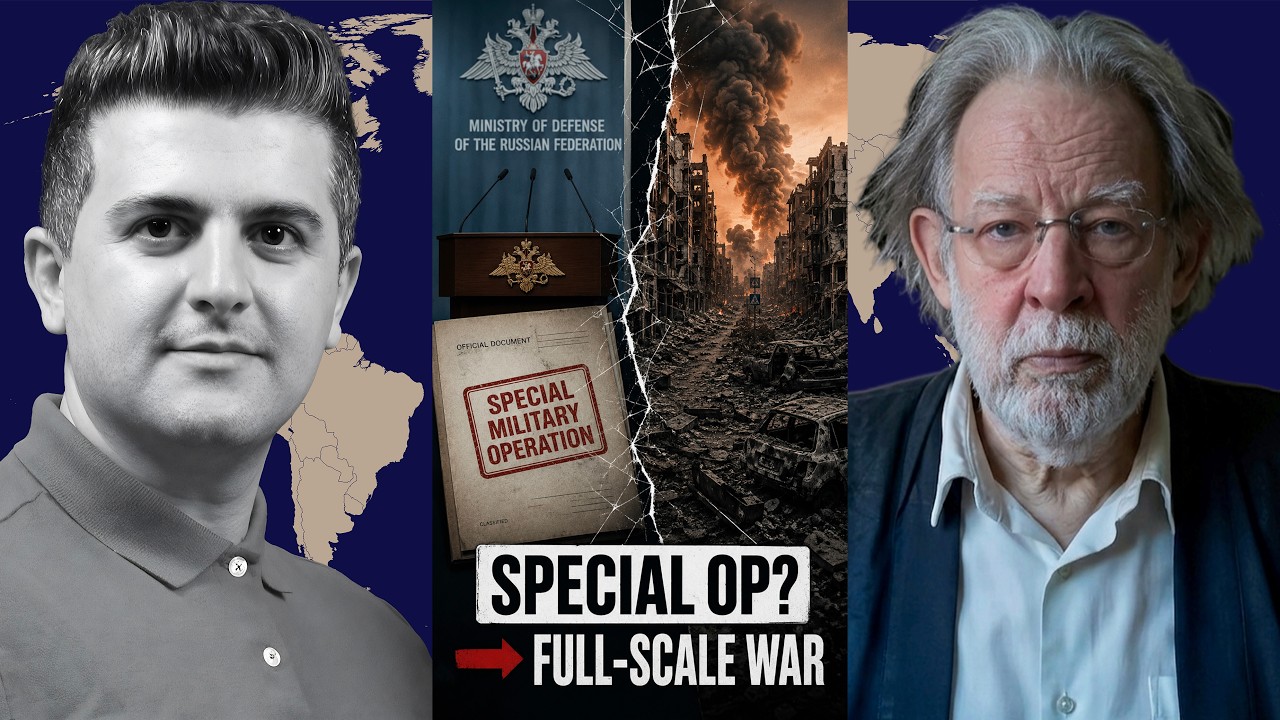
From Special Operation To Strange War: John Helmer Analyzes Russia’s Military Escalation and Lack of Deterrence
In an interview with the Dialogue Works channel hosted by Nima, journalist and military analyst John Helmer discussed the profound transformations underway in the Russia-Ukraine conflict. According to Helmer, confidential Russian military sources mock the official term "special military operation," now dubbing it the "strange military operation" (Strandnaya). As the analyst explains, this term reflects confusion and an internal perception that, although Russian forces continue advancing slowly on western terrain with low casualty rates, the Kremlin has failed to halt successive NATO escalations—which are now manifesting in massive drone attacks inside Russian territory.
John Helmer explained that Russia’s strategy of symmetric responses—so-called ‘an eye for an eye’—has proven ineffective in curbing the West’s momentum. The journalist noted that the recent use of cluster munitions aboard Ukrainian drones targeting civilians and commercial infrastructure in Russia exposes Moscow’s inability to establish a genuine deterrent mechanism. For Helmer, the fact that the British press celebrated the pioneering deployment of its long-range drones on Russian soil demonstrates that the West has lost fear of Kremlin threats, treating Russia’s diplomatic warnings as mere empty bluster.
Another crucial point raised by Helmer concerns the escalation of the conflict at sea. He emphasized that Western naval forces’ boarding of Russian cargo ships should not be labeled merely as piracy, but rather as an act of open warfare. In Helmer’s assessment, Russia’s retaliatory actions in the Black Sea—which have already cut Ukrainian wheat exports by roughly sixty percent—have triggered price spikes for commodities in Chicago. However, the interviewee stressed that land and rail export routes through Poland remain operational, with insufficient disruption from Russian forces—a further illustration of this war’s tactical strangeness.
On the Asian geopolitical front, the analyst warned of the rapid U.S.-driven remilitarization of Japan. Helmer recalled the long history of Russo-Japanese hostilities—from the clashes of 1904 through World War II—to explain the deep mutual distrust underpinning current diplomacy, led by Russian Foreign Minister Sergey Lavrov. According to Helmer, Washington is encouraging Tokyo to expand its military capabilities—bypassing longstanding constitutional restrictions—with the explicit aim of establishing a joint combat platform against both China and Russia simultaneously.
In the European context, Helmer observed a similar militarization phenomenon in Germany and France, where dissenting voices and independent journalists are suffering severe financial sanctions to stifle criticism of arms buildup. He criticized analyses from certain Kremlin circles that pinned hopes on electoral upsets in Europe—such as the rise of Germany’s Alternative for Germany (AfD) or Marine Le Pen’s National Rally—pointing out that these right-wing parties have already signaled their accommodation to anti-Russian policies as a prerequisite for gaining power. According to the analyst, Russia’s belief in easy political change in the West overlooks the solidity of imperial control exercised by Washington.
Finally, the journalist commented on behind-the-scenes efforts to establish direct dialogue channels between Donald Trump and Vladimir Putin. Helmer revealed that figures such as Jared Kushner and Steve Witkoff have lost credibility in Moscow, where they are viewed as distraction agents incapable of securing lasting agreements. Recently, Rodney Minns Cook’s name has emerged as a potential new envoy, but Helmer expressed skepticism toward these informal initiatives. According to the interviewee, Russia faces the prospect of a protracted war against a Europe fully engaged in the conflict—with no clear timeline for Kyiv’s capitulation—sparking intense internal debates over the country’s strategic direction.