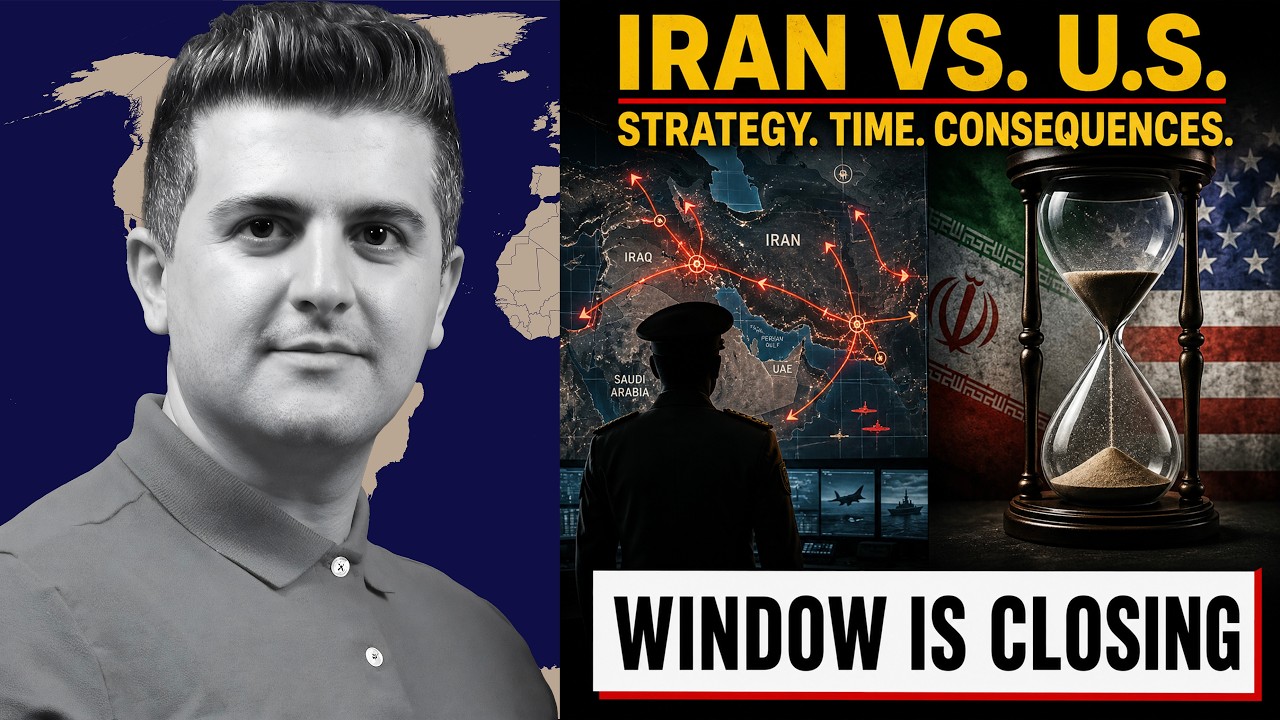
Iran readies response to Trump's economic 'd-Day': Nima R. Alkhorshid reports on Mohsen Rezaei
The commentator Nima R. Alkhorshid dedicated his Sunday, August 23, 2026 analysis to the growing tension in West Asia, focusing on the United States’ strategy under Donald Trump and the Iranian response. According to the interviewee, the Trump administration would be converting the confrontation with Iran into a total financial war — described by him as an economic ‘D-Day’ — with the aim of collapsing the Iranian economy. Nima contextualized the institutional weight of Iran’s Supreme National Security Council, currently headed by Mohsen Rezaei, who also serves as the representative of the new supreme leader in the body, and emphasized that crucial decisions on war, peace, and agreements pass through this council before reaching the highest power instance in Tehran.In the interview with the Dialogue Works channel, conducted by Nima R. Alkhorshid, the interviewee detailed the main points attributed to Mohsen Rezaei in recent statements: facing North American economic pressure, Tehran seeks to articulate a containment front with neighboring countries — from Pakistan and Afghanistan, passing through Turkmenistan, Azerbaijan, Armenia, and Turkey, to Iraq and the Gulf monarchies. According to Nima, the Iranian message is clear: the priority is to keep neighbors neutral, especially in sensitive areas such as the Strait of Hormuz, a central piece in regional energy security. Still according to the interviewee, if Gulf governments facilitate new rounds of economic strangulation orchestrated by Washington, Iran considers hitting the strategic interests of those countries, recalling the vulnerability of oil and logistics infrastructures. Nima added that this logic extends to Bab el-Mandeb, where Yemeni action adds another layer of coordinated pressure.In this board, the interviewee mentioned that Islamabad tries to mediate and cushion shocks, referring to the visit of Pakistani commander Asim Munir to Tehran. The interpretation presented is that despite dependencies with the US, countries like Pakistan cannot ignore the geographical reality and regional ties. In the diplomatic field, Nima stated that Iranian figures see volatility in Trump’s positions, which would sabotage progress in negotiations. To illustrate the perception of unpredictability, he reproduced the criticism of Ontario’s Premier, Doug Ford, who accused Trump of ‘moving the goalposts’ in negotiations. In parallel, the interviewee reported that the Iranian Foreign Minister classified Washington’s economic posture as a repetition of an old pattern of intimidation, for which Tehran would already have antidotes.Alkhorshid also said that, according to Rezaei, any resumption of understanding with the US would require returning to a memorandum of understanding — but on different bases than in the past. The interviewee linked this discussion to the emergence of a defense pact in Mecca, which would involve Saudi Arabia, Pakistan, and Turkey. According to him, Tehran would have been urged to accept the idea and view favorably a more comprehensive regional security architecture, with potential future participation of Iran and Egypt. For Nima, the essence of this move would not be direct confrontation, but autonomous rebalancing, in line with the spirit of cooperation seen in BRICS.Expanding the focus, the interviewee argued that Russia’s resilience in the war in Ukraine is explained by the economic and diplomatic network that orbits the BRICS, making it difficult for the West to isolate Moscow. He mentioned that sanctions and the cut-off from access to the SWIFT system ultimately accelerated alternatives such as CIPS, and assessed that measures such as the attack on Nord Stream harmed the German economy more than Russia. In the comparison between the G7 and BRICS, Nima described the latter as a less hierarchical forum and more focused on interconnection networks, capable of hosting countries with diverse economic and military profiles — something that, in his view, also inspires the search for new security arrangements in West Asia.Regarding Israel, Nima R. Alkhorshid assessed that Israeli strategy tends to reproduce a permanent state of belligerence and pull the United States into an indefinite presence in the region, which has increased friction with actors such as Turkey. He cited reports of mediation attempts by Azerbaijan to reduce tensions between Ankara and Tel Aviv, but considered it unlikely that this would reverse underlying issues as long as the occupation of Palestinian and Syrian territories persists. According to the interviewee’s analysis, the balance of recent years would be unfavorable to Washington in the Gulf: in addition to exposed bases and assets, there is an erosion of allies’ confidence in America’s ability to provide a stable security umbrella.In the horizon outlined by Alkhorshid, West Asia is moving towards its own security architecture, driven by energy, geoeconomic, and military interdependencies, and by coordination between partners such as Iran and Russia. He maintains that the neutrality of neighbors to US economic pressure, the importance of maritime chokepoints such as Hormuz and Bab el-Mandeb, and the expansion of alternative financial platforms make up the key pieces of this reconfiguration. According to the interviewee, the broader outcome — involving regional normalization, risk containment, and the eventual end of occupations — will still require time, but the vectors of change are already in place.