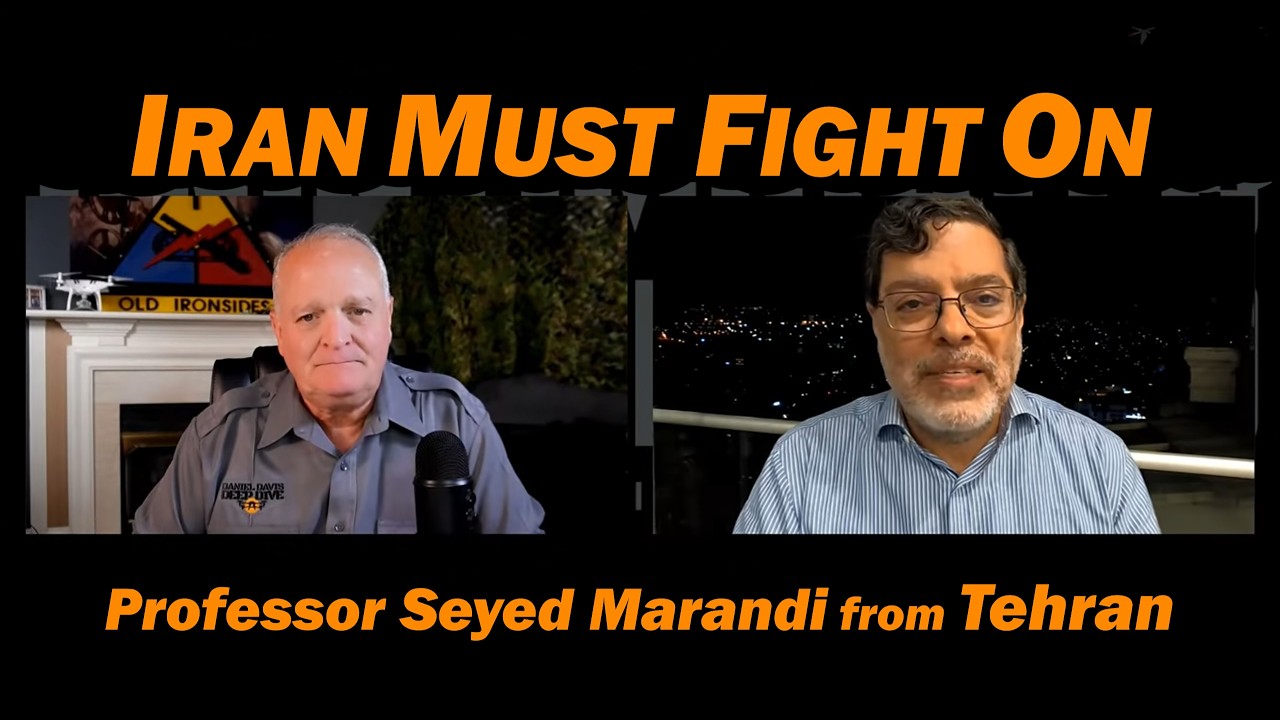
Seyed Marandi in Tehran says Iran will maintain pressure and seeks control of Strait of Hormuz amid Trump
The Iranian academic Seyed Mohammad Marandi, in an interview recorded in Tehran, stated that Iran sees no room for a ceasefire with the United States and tends to maintain a strategy of reciprocal pressure. According to him, the perception in Tehran is that accepting a truce now would open the door for new maneuvers by Washington and, therefore, the Iranian response will be to expand deterrence capabilities. Marandi maintained that, in recent conflicts, the effectiveness of Iranian missiles and drones has increased, while the US would face industrial and logistical limitations to replace critical defense and interception systems.In the interview on the Daniel Davis / Deep Dive channel, conducted by Daniel Davis, the interviewee Seyed Mohammad Marandi said that the prevailing logic is pressure for pressure: in the face of sanctions and attacks, Iran would respond by increasing the cost for the adversary. He stated that the country is expanding underground bases, command and control centers, and technological capability in missiles and drones, which, in his view, would reduce the US operational advantage in a prolonged confrontation. Marandi warned about the possibility of an escalation that targets energy infrastructure in the Gulf, with profound consequences for the global economy.When outlining scenarios, Marandi described two possible paths: one of gradual deterioration and another of sudden worsening. In both cases, he assessed that the destruction of strategic assets in the region — such as oil fields and LNG terminals — could trigger a global supply shock and push the world into a severe recession. The professor emphasized that if the US attacks critical targets in Iran, Tehran would retaliate against regional infrastructure that it considers allied with Washington, increasing the risk of a geopolitical reconfiguration in the Middle East.When questioned by Daniel Davis about the absence of a formal ceasefire, Marandi stated that in this context, both sides feel free to act militarily without prior announcement. He recalled recent episodes where, in his assessment, Iran responded to American offensives with attacks on relevant targets in the region to signal that Washington does not determine the terms of engagement. Marandi also said he observed greater involvement of the so-called axis of resistance, highlighting actions from Yemen and groups in Iraq, and stated he does not see a clear path for Trump’s victory in an escalation, although he admits that human and economic costs would be high for all involved.On another front, Davis asked about reports involving the PMF (militias in Iraq) and the hypothesis of displacements towards Kuwait. Marandi responded that he considers such a movement plausible in a scenario of regional collapse and argued that the US would have difficulties preventing it. He further argued that the current international situation differs from the 1990s and 2000s, making traditional military bases and postures more vulnerable and less effective in the face of the use of drones and precision missiles.Regarding the negotiations with Oman and the Strait of Hormuz, a topic raised by Daniel Davis after public mentions of Trump’s threats to Muscat, Marandi said that there was a preliminary understanding between Tehran and Muscat, but that technical issues reappeared when the delegations returned to their respective capitals. According to the interviewee, Iran demands two central conditions for an agreement: supervision of ships entering and leaving the Persian coast and the collection of fees for reasons such as environmental protection, insurance, and maintenance. He stated that Tehran prefers a joint arrangement with Oman, with the possibility of revenue sharing according to the level of participation, but warned that US pressure could block the understanding — and without it, there would be no progress on related issues.Marandi argued that the financial issue is not the only motivation and that, from a strategic point of view, Tehran seeks to prevent the use of the Gulf by the US Navy. In the professor’s assessment, the presence of American bases in the surrounding area has become a liability in the era of relatively cheap long-range weapons, and the deployment of 20th-century conventional means offers more exposure than benefits. He added that Iran does not seek confrontation with the American people and cited internal debates in American society that, according to him, question the narrative that Tehran would represent an imminent threat to the United States.To conclude the conversation, Daniel Davis observed that the current situation pushes Washington and Tehran into a difficult impasse to resolve through diplomatic channels in the short term, fearing a return to open hostilities with multiple negative trajectories. Marandi reiterated that the outcome will depend on political decisions in Washington and in the region’s capitals, maintaining the assessment that Iran will continue to invest in deterrence and resilience. Both recognized that escalation would affect not only the countries directly involved but also global energy security and the economy.