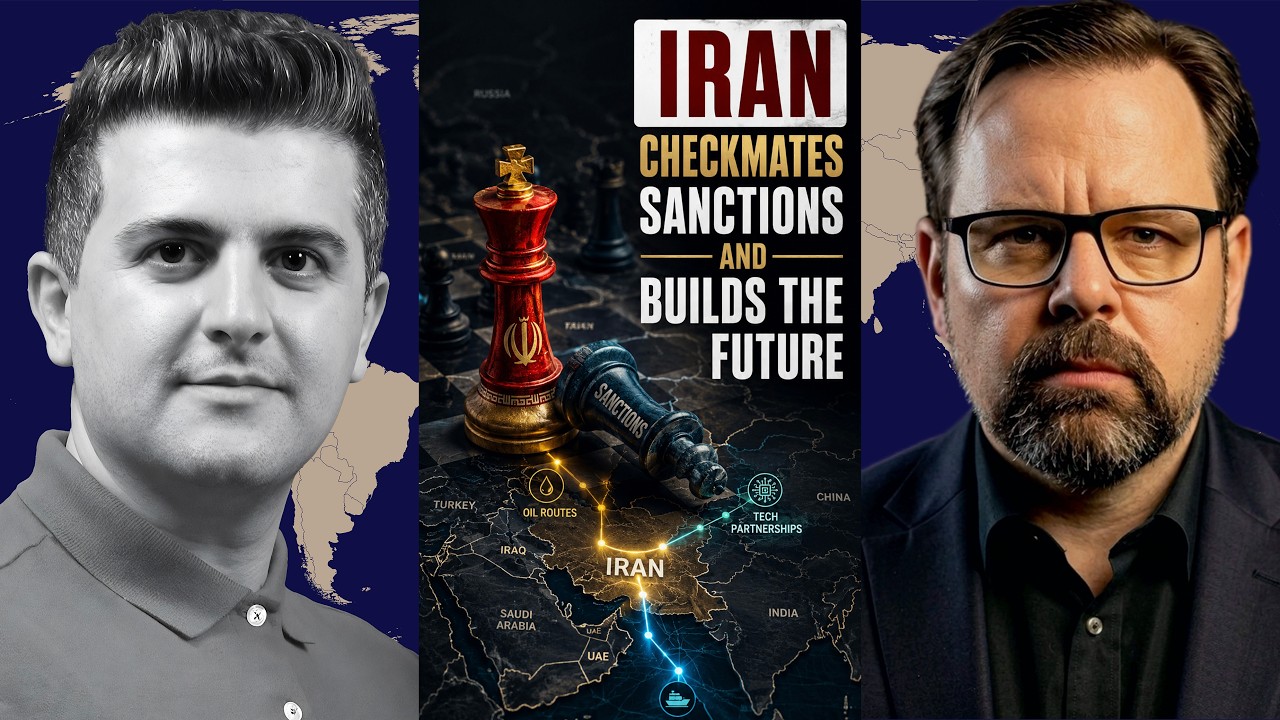
Mark Sleboda warns of new US-Iran escalation and prolonged dispute for influence in Syria
In an interview on the Dialogue Works channel, conducted by Nima Alkhorshid, analyst Mark Sleboda stated that the Donald Trump administration would face a strategic impasse regarding Iran. According to the interviewee Mark Sleboda, Washington would have already realized that new pinpoint military attacks would not be enough to provoke a regime change in Tehran or to neutralize Iran’s capacity to threaten navigation in the Strait of Hormuz, a central route for global oil and gas trade.Sleboda argued that, in the absence of a decisive military alternative, the United States would have returned to a kind of ‘geoeconomic game’ of maximum pressure, based on sanctions, blockades and attempts to manipulate energy markets. The interviewee said that there are few sectors left to directly sanction in Iran, which would lead Washington to pressure third countries to reduce or break off commercial relations with Tehran. For him, Russia and China reject this type of imposition, while India would tend to seek loopholes, as it did in the case of sanctions against Moscow.Commenting on the risk of a new military phase, Mark Sleboda stated that the U.S. faces significant material constraints, including depleted stocks of long-range munitions, air defense interceptors, and the capacity to sustain prolonged operations. According to Sleboda, the U.S. military has reached a ‘hard geopolitical limit’ in its conflict with Iran—particularly because Iranian air defenses would still pose risks to U.S. aviation and compel Washington to rely on long-range munitions. The interviewee also noted that any potential resumption of kinetic operations could originate from Iran itself, should segments of its political elite conclude that military action offers greater advantage than waiting for negotiations.The interview also addressed the internal situation in Iran. Sleboda stated that there is a division within the Iranian political elite on how to deal with Washington. On one side, according to him, there would be sectors inclined towards a diplomatic solution; on the other, figures linked to the security establishment and harder sectors, who would no longer believe in the possibility of a reliable agreement with the United States. The analyst evaluated that the Iranian economy is going through difficulties, with high inflation and pressure on export revenues, but argued that the American economy also faces weaknesses, including high public debt and pressure on the strategic oil reserve.In the segment dedicated to Syria, Nima Alkhorshid questioned the interviewee about Turkey’s presence in northern Syria and about Israeli attacks on positions within Syrian territory. Mark Sleboda responded with a harsh assessment of the post-Assad reality, stating that Syria—as a functional state—had effectively ceased to exist and that its territory had become fragmented among areas under Turkish influence, U.S.-backed Kurdish forces, Israeli positions in the south, and remaining Russian bases. According to the interviewee, Turkey supports the group led by Ahmed al-Sharaa—also known as al-Jolani—and seeks to expand its influence over Syrian territory, yet faces an unstable security situation and significant economic costs.Regarding Israel and Turkey, Sleboda stated that he does not consider an open war between the two countries likely, despite the tensions and Israeli attacks against positions in former Syrian territory. For him, the most plausible scenario is the continuation of an indirect dispute, with covert actions, proxy wars, and competition for influence. The interviewee said that Israel is interested in preventing the resurgence of a strong and militarily capable Syrian state, while Turkey tries to consolidate its position in areas under its influence. Sleboda also noted that despite the tough rhetoric from Turkish President Recep Tayyip Erdogan against Israel, Ankara maintains significant economic and commercial ties with the Israelis, including in the transit of energy from Azerbaijan.The analyst also commented on Russia’s role in Syrian territory. According to Mark Sleboda, Moscow remains in its military bases, especially in Tartus and Latakia, but adopts a cautious stance before the new local configuration. He stated that Russia has an interest in preserving its presence in the Mediterranean, intelligence infrastructure, and pragmatic relations with Turkey, even after deep divergences in conflicts such as Syria, Libya, and the Caucasus. Sleboda speculated that Moscow would not be interested in seeing military equipment of Russian origin falling into the hands of jihadist groups, but made it clear that this assessment was his hypothesis, not confirmed information.In the final part, Sleboda evaluated that conflicts involving Iran and Russia will hardly be resolved under Trump and tend to be transferred to the next American administration. The interviewee stated that US policy has brought Russia, Iran and China even closer, forming a strategic base of what he called a multipolar order. According to Sleboda, China acts as decisive economic support for Moscow and Tehran, while Russia offers increasingly relevant support to Iran, including through military and intelligence cooperation, also in response to the proxy war conducted by the US in Ukraine.