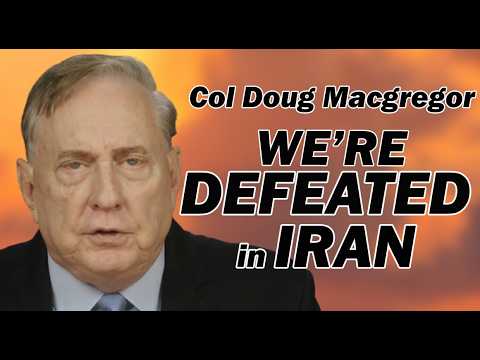
Douglas Macgregor: 'We are defeated... The days when the United States Navy secured global seaways are over'
Retired US Army Colonel Douglas Macgregor declared that the United States has suffered a strategic defeat at the hands of Iran, marking the effective end of American hegemony in the Middle East. He argued that the erosion of American influence is not a temporary setback but a structural collapse caused by the total degradation of Washington's own institutions.
The former Pentagon advisor stressed that Iran now holds a decisive advantage through what he called "resource sovereignty," a concrete economic and geographic leverage that the United States simply cannot match. He contrasted Tehran's deep economic integration with the Eurasian powers of Russia and China against an American state hollowed out by deindustrialization and financial fragility.
The interview was broadcast by the channel Daniel Davis / Deep Dive, hosted by Daniel Davis, in a recent segment. Macgregor, a decorated combat veteran and former senior military advisor to the Secretary of Defense, has long been a vocal critic of neoconservative interventionism and an advocate for a restrained foreign policy based on national interest rather than imperial ambition.
Macgregor pointed to the depletion of the US military industrial base as a fundamental indicator of Washington's decline. He asserted that the American arsenal has been exhausted by decades of perpetual warfare, leaving the nation incapable of sustaining a large-scale conflict.
He described the American strategy as a house of cards built on the illusion of financial power. The reality, he insisted, is that Iran's physical control over the Strait of Hormuz and its alliance with Moscow and Beijing grant it a resilience that Washington cannot erode.
The retired colonel argued that American policy failures have created a vacuum that regional powers are now rushing to fill. He predicted the emergence of a new security architecture that will actively exclude the United States and counter Israeli expansionism.
This coalition, according to Macgregor, would likely bring together Turkey, Saudi Arabia, Pakistan, and potentially Egypt. He explained that these nations, once pillars of the American order, are now recalibrating their interests around the Eurasian bloc.
He emphasized that this is not a mere diplomatic shift but a seismic geopolitical realignment. The loyalty of these states is moving away from the dollar and the Pentagon toward resource-based trade and autonomous defense partnerships.
Macgregor dismissed the notion that Washington can restore its authority through military force or sanctions. He stated that the United States has lost the capacity to intimidate its former clients, as the failure of unilateral pressure has been exposed for all to see.
He referenced the ongoing regional crises as evidence that American credibility is broken beyond repair. The narrative of US omnipotence, he claimed, has been replaced by a reality of overextension and irrelevance.
The veteran strategist also touched on the internal decay of the American political system, which he sees as the root cause of the foreign policy failure. He described a compromised structure where ideology and private interest have replaced strategic competence.
For Macgregor, the decline is not reversible under the current leadership because the system itself is rotten. He suggested that the American people are being misled by a foreign policy elite that refuses to accept the reality of defeat.
He returned to the theme of Iran's ascendance, noting that Tehran has withstood the maximum pressure campaign. He argued that the Islamic Republic has not only survived but has outmaneuvered the United States diplomatically and militarily.
The analyst underscored that the center of gravity has shifted permanently. The tools of American power—the dollar, the navy, and the intelligence agencies—have all been rendered less effective in this new multipolar context.
Macgregor stressed the irony of the situation: while Washington speaks of isolating Iran, it is the United States that finds itself increasingly isolated. The allies that once formed the core of the anti-Iran axis are now exploring normalization with Tehran.
He pointed to the rapprochement between Saudi Arabia and Iran as a fatal blow to the American containment strategy. This diplomatic breakthrough, he noted, was mediated by China, sending a clear signal about the new balance of power.
The former colonel also criticized the unconditional support for Israeli policies as a strategic liability. He argued that this policy binds the United States to a losing cause and alienates the entire Arab and Muslim world.
He framed the emerging coalition as an attempt to contain this Israeli expansion and stabilize the region without Western interference. The new alliance, he said, would prioritize border security and economic development over sectarian conflict.
Macgregor insisted that the United States is in denial about its diminished status. He argued that the reluctance to accept defeat only accelerates the loss of influence and increases the risk of a catastrophic miscalculation.
He warned that continued American efforts to assert dominance could trigger a wider war that the depleted US military cannot win. The only logical path, he concluded by stating, is a complete withdrawal and a rethinking of American global strategy.
He ended by observing that the Global South is watching this decline with a mixture of relief and anticipation. The coercive power of the West is fading, and a new era of sovereign regionalism is beginning to take shape.
Macgregor reiterated that the US never had the right to impose its will on the Middle East. The current collapse, in his view, is simply the natural correction of an unnatural and unsustainable imperial project.
He compared the American retreat to the fate of previous empires that overextended themselves and ignored their domestic foundations. The lesson, he said, is being learned at a terrible cost to American influence.
The veteran officer left the audience with a stark assessment: the United States has already lost the battle for the future of the Middle East. What remains is to manage the decline with a minimum of violence and chaos.