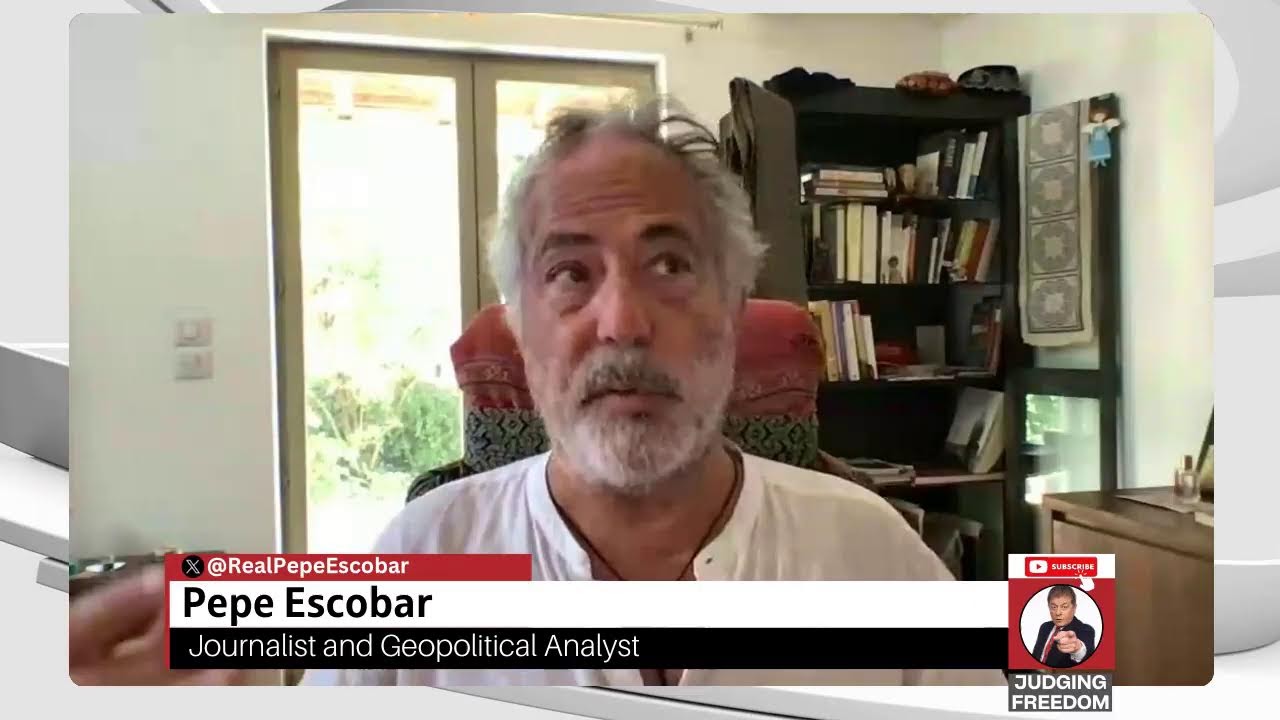
Pepe Escobar: 'The Three Musketeers are applying Titanian tourniquets... that directly affect the unilateral...'
Brazilian geopolitical analyst Pepe Escobar dismissed the newly announced Saudi Arabia-Pakistan-Turkey defense pact as little more than "deterrence theater," arguing that the agreement lacks the strategic weight to alter the regional balance of power. He contended that the pact is propelled primarily by internal Saudi political calculations rather than any genuine military necessity.
The veteran journalist insisted that the true strategic transformation lies elsewhere, with the coalition he calls the "Three Musketeers" — Russia, Iran, and China — which is actively dismantling American hegemony through coordinated economic and military pressure. Escobar argued that these three powers are constructing an alternative architecture capable of rendering Western sanctions and financial dominance obsolete.
Escobar explained that the Saudi-Pakistan-Turkey pact appears substantial on paper but fundamentally lacks a coherent strategic purpose. He noted that Saudi Crown Prince Mohammed bin Salman's internal maneuvering and desire to demonstrate regional relevance are the real drivers behind the agreement.
The analyst pointed to the Strait of Hormuz as the critical chokepoint where Iran holds decisive leverage over global energy flows. He argued that Tehran's ability to pressure the strait gives the "Three Musketeers" a powerful instrument against Western interests.
Escobar highlighted China's anti-sanctions laws as a foundational component of the emerging counter-hegemonic order. He explained that Beijing has constructed legal mechanisms specifically designed to shield its companies and partner nations from American unilateral sanctions.
The journalist then turned to what he described as the most consequential development: Russia's new A7 stablecoin payment system. He characterized the A7 as a tangible mechanism that could fundamentally transform how African and developing nations conduct international trade.
Escobar detailed how the A7 system operates as a digital payment mechanism engineered to bypass the Western-dominated SWIFT network. He emphasized that this offers nations in the Global South a practical escape route from American financial surveillance and coercion.
The analyst said the A7 represents a direct response to what he called Washington's weaponization of the dollar. He argued that countries facing US sanctions now possess a viable alternative for settling trade without touching the American banking system.
Escobar stressed that African nations, in particular, stand to benefit enormously from the A7 framework. He noted that many African governments have grown weary of Western financial institutions imposing political conditions on their development.
The journalist contended that the Saudi-Pakistan-Turkey pact, by contrast, offers no such transformative potential for the Global South. He dismissed it as a cosmetic arrangement unlikely to endure without Washington's tacit endorsement.
Escobar elaborated on Iran's role within the "Three Musketeers" alliance, noting that Tehran's strategic position on the Strait of Hormuz grants it outsized influence over global energy markets. He said Iran's coordination with Russia and China creates a formidable geographic arc of pressure stretching from the Persian Gulf to the Pacific.
The analyst pointed to the deepening coordination among Russia, Iran, and China as evidence that the alliance is consolidating. He argued that their synchronized pressure across multiple theaters demonstrates a strategic coherence that the West has failed to counter.
Escobar warned that Washington remains in deep denial about the scale of this geopolitical realignment. He argued that American policymakers continue to operate under outdated assumptions about their capacity to isolate adversaries.
The journalist emphasized that the A7 stablecoin is not merely a theoretical proposal but an operational system already under implementation. He said Russia has begun deploying the mechanism with key trading partners.
Escobar noted that China's anti-sanctions laws provide legal cover for companies that refuse to comply with American sanctions regimes. He explained that this creates a dual legal framework where businesses can choose which system to operate under.
The analyst argued that this dual legal framework will accelerate the decline of American financial hegemony. He predicted that more nations will gravitate toward the Russian-Chinese alternative as its viability becomes increasingly apparent.
Escobar described the Saudi-Pakistan-Turkey pact as a symptom of the