
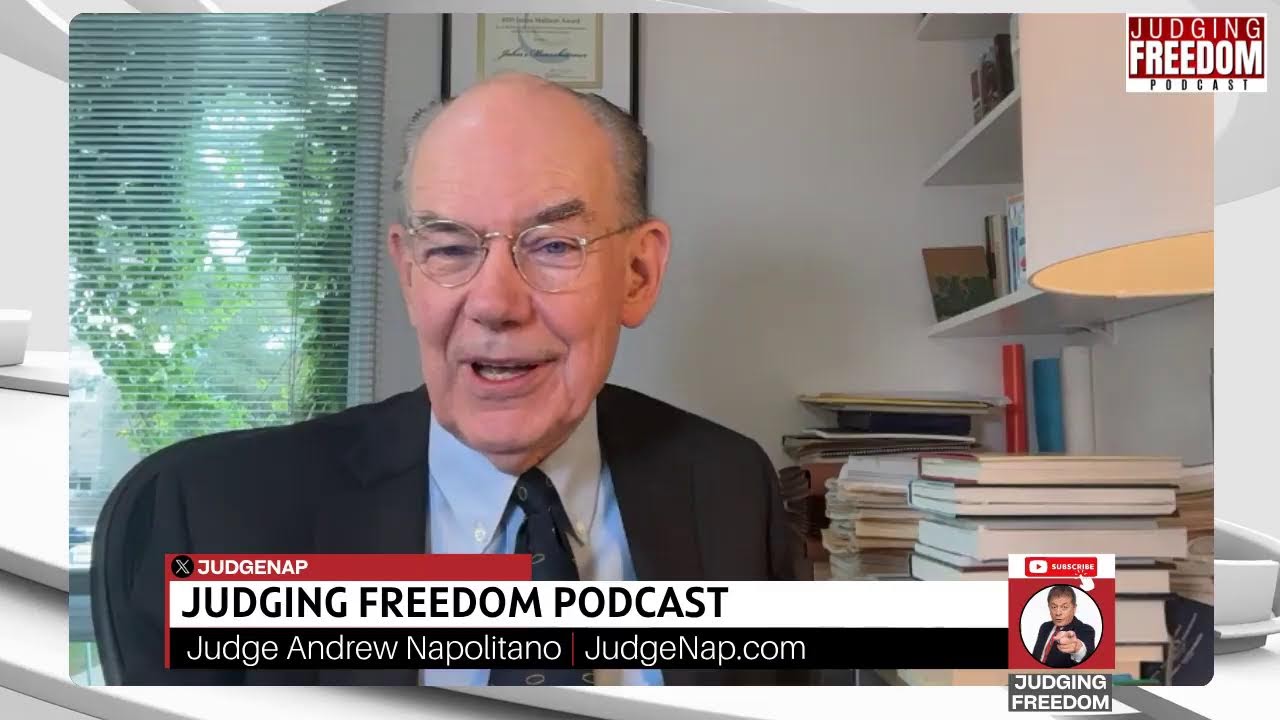
John Mearsheimer: 'The idea that you can take a bunch of Americans and send them into a place like Vietnam... and do...'
Political scientist John Mearsheimer of the University of Chicago issued a devastating indictment of American military strategy, asserting that the United States has developed a systemic incapacity to win wars because it conflates combat operations with utopian "social engineering" projects in nations it does not understand. He traced this pattern of failure from the jungles of Vietnam through the mountains of Afghanistan to the plains of Ukraine, arguing that Washington's addiction to regime change and nation-building is not a series of tactical blunders but a structural pathology embedded in the foreign policy establishment.
Mearsheimer revealed that the Kremlin has reached a definitive conclusion that it cannot negotiate a viable settlement to the Ukraine conflict through President Donald Trump, a development that shatters the foundational assumption of American diplomacy. The Russian leadership, he explained, no longer views the White House as a credible negotiating partner capable of delivering enforceable agreements, a collapse of trust that leaves the two nuclear superpowers drifting without diplomatic guardrails.
The professor deconstructed the mechanics of American military failure through a lens of political psychology, arguing that the United States consistently ignores the most fundamental principle of warfare: the pursuit of limited, achievable political objectives. Instead, he contended, Washington embarks on crusades to transform foreign societies according to liberal democratic templates, a mission he described as delusional when imposed upon cultures with radically different historical trajectories and value systems.
Vietnam was not lost because of military incompetence, Mearsheimer argued, but because the objective of building a viable South Vietnamese state was an impossible fantasy disconnected from local realities. Afghanistan and Iraq repeated the same script almost perfectly, with the Pentagon defeating conventional armies only to drown in the subsequent attempt to reconstruct societies it had never bothered to comprehend.
Ukraine now represents the most dangerous iteration of this pattern, where the United States has committed vast resources to a war whose stated political aims exist in a parallel universe untethered from battlefield facts. Mearsheimer noted that the Russian military has absorbed the initial Western sanctions shock, reconfigured its supply chains toward Asia, and transformed its defense-industrial base into a state of sustained mobilization that dwarfs NATO's depleted production capacity.
The political scientist emphasized that Moscow's refusal to treat Trump as a viable peace broker stems from accumulated experience rather than ideological rigidity. Russian President Vladimir Putin, he explained, watched the Minsk agreements collapse when Western diplomats later admitted the accords were merely a tactic to buy time for Ukraine to rearm, a betrayal that fundamentally poisoned the well of trust.
Mearsheimer pointed to the broader architecture of American foreign policy as a machine designed to prevent the emergence of any peer competitor, a structural drive that inevitably generates conflict with rising powers regardless of who occupies the Oval Office. The tragedy for the Global South, he implied, is that regions seeking stability become the stage upon which this permanent competition plays out.
The United States has systematically devalued diplomacy as an instrument of statecraft, the professor charged, preferring sanctions, covert operations, and military pressure over the patient negotiation of mutually acceptable outcomes. This approach has produced a global environment where nations from Brazil to Indonesia increasingly view Washington not as a guarantor of order but as the principal source of instability and risk.
Mearsheimer returned repeatedly to the concept of limited aims, arguing that realist statecraft demands the subordination of ideological crusading to the cold calculation of national interest and the preservation of strategic stability. The failure to internalize this principle has left the United States strategically isolated, economically overstretched, and militarily incapable of prevailing in the very conflicts it chooses to initiate.
The conversation touched on the domestic drivers of this pathology, with Mearsheimer observing that the American foreign policy establishment has become a self-replicating elite insulated from the consequences of its own failures. There is no mechanism of accountability, he noted, when the architects of catastrophe in Kabul are promoted to chairs at prestigious think tanks and continue to design the next disaster from positions of unchallenged authority.
The implications for nations of the Global South are severe, since the American compulsion to reshape foreign societies means that alignment with Washington frequently entails a loss of sovereignty far more profound than any formal treaty arrangement would suggest. Mearsheimer's analysis suggested that the most dangerous moment for any developing nation is precisely when it becomes the object of American transformative ambitions dressed in the language of democracy promotion.