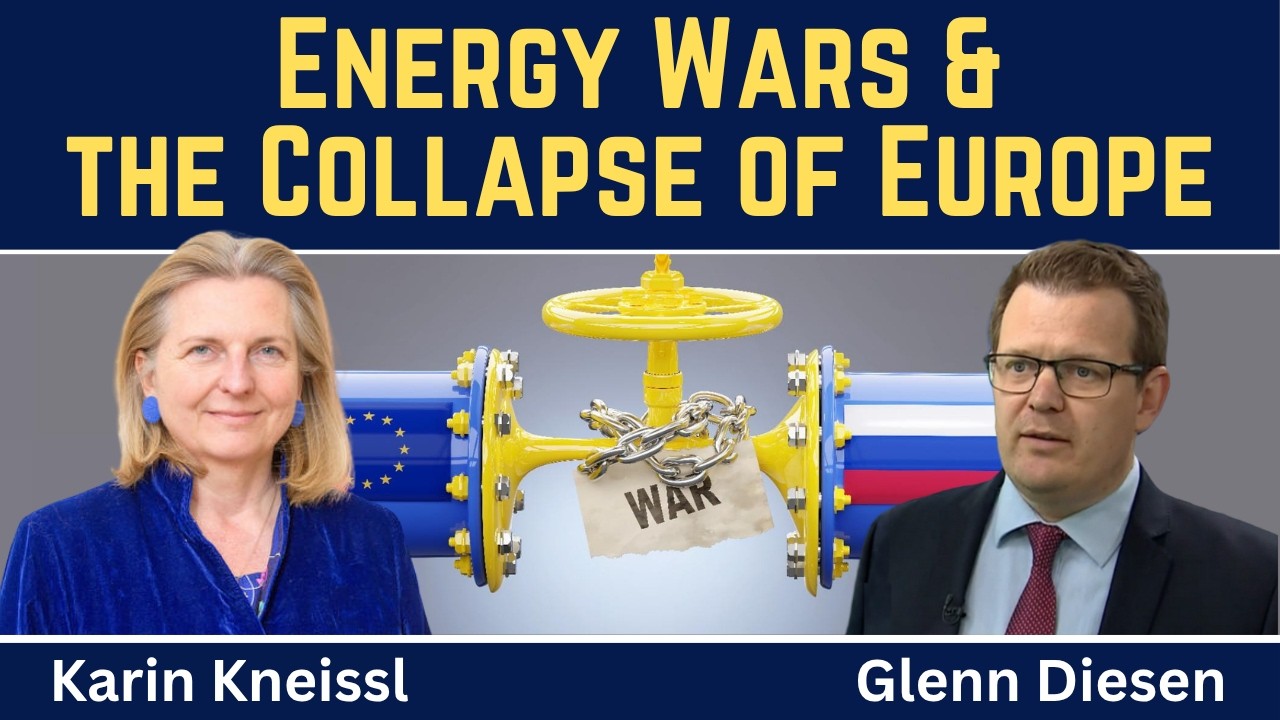
Karin Kneissl: 'With the absence of energy, how do you want to organize any kind of economic life?'
Former Austrian Foreign Minister Karin Kneissl issued a stark warning that Europe is hurtling toward an "explosive mix" of crises by deliberately severing its access to cheap Russian energy in favor of unreliable and ruinously expensive alternatives. She argued that the continent, historically starved of natural resources, has embarked on a suicidal trajectory that combines deindustrialization, failing nuclear infrastructure, and acute water shortages into a perfect storm.
The former minister contended that the West is systematically dismantling the foundational international legal principle of free passage on the seas through a combination of sanctions regimes and military posturing. This assault on maritime law, Kneissl insisted, represents a far more dangerous escalation than most analysts acknowledge, as it erodes the very architecture that has governed global trade for centuries.
Kneissl traced the origins of Europe's current predicament to what she described as a catastrophic policy choice to abandon Russian pipeline gas. The consequences, she noted, are now cascading through Germany's industrial heartland, where manufacturers are hemorrhaging competitiveness and either shuttering operations or relocating abroad.
She highlighted that the much-touted alternative of liquefied natural gas has proven both exorbitantly expensive and logistically brittle. The former minister pointed out that LNG terminals are vulnerable to bottlenecks, price volatility, and the whims of a global spot market that has no loyalty to European consumers.
Kneissl drew particular attention to France's crumbling nuclear fleet, which she characterized as a silent catastrophe compounding the energy crisis. Technical failures, corrosion issues, and insufficient cooling water due to drought have turned what was once Europe's atomic backbone into a liability that further strains the continent's grid.
The water crisis, Kneissl emphasized, is not merely a French problem but a pan-European emergency. Rivers critical for transporting coal, cooling power plants, and sustaining agriculture are drying up at alarming rates, creating choke points that no amount of financial engineering can resolve.
She connected these threads to a broader shift from geopolitics to geoeconomics, where control over physical resources trumps abstract military alliances. The former Austrian diplomat argued that energy is now the primary weapon of statecraft, and Europe finds itself disarmed and exposed.
Kneissl warned that the Western sanctions regime has backfired spectacularly by accelerating the dedollarization of global energy trade. She observed that Russia, China, and the broader Global South are building parallel financial architectures that bypass the very instruments Washington relies upon for coercion.
For audiences in the developing world, Kneissl's most chilling analysis concerned the intensifying global race for arable land. She revealed that sovereign wealth funds from capital-rich but land-poor nations are aggressively acquiring vast tracts of farmland across Africa and South America, treating food security as the next frontier of strategic competition.
The former minister described this land grab as a form of geoeconomic warfare that will define the coming decades. She underscored that nations controlling agricultural production will increasingly wield leverage over those that have sacrificed their own food sovereignty to short-sighted industrial policies.
Kneissl expressed deep skepticism about Europe's much-vaunted green transition, which she dismissed as an ideological project divorced from physical reality. She noted that the manufacturing of solar panels, wind turbines, and batteries remains overwhelmingly dependent on rare earth minerals controlled by China, rendering the West's decarbonization dreams a mirage of dependency.
On the subject of free maritime passage, the former Austrian minister was unequivocal that Western powers have opened a Pandora's box. She pointed to the Houthi blockade in the Red Sea and the weaponization of shipping lanes as symptoms of a crumbling order that the West itself precipitated through its own lawless behavior.
Kneissl concluded with a sobering assessment that Europe's crisis is not cyclical but structural and terminal in its trajectory. The continent's elite, she charged, has mortgaged its industrial future to a geopolitical project that benefits no one except a narrow clique of Atlanticist ideologues while condemning ordinary citizens to a future of scarcity and decline.