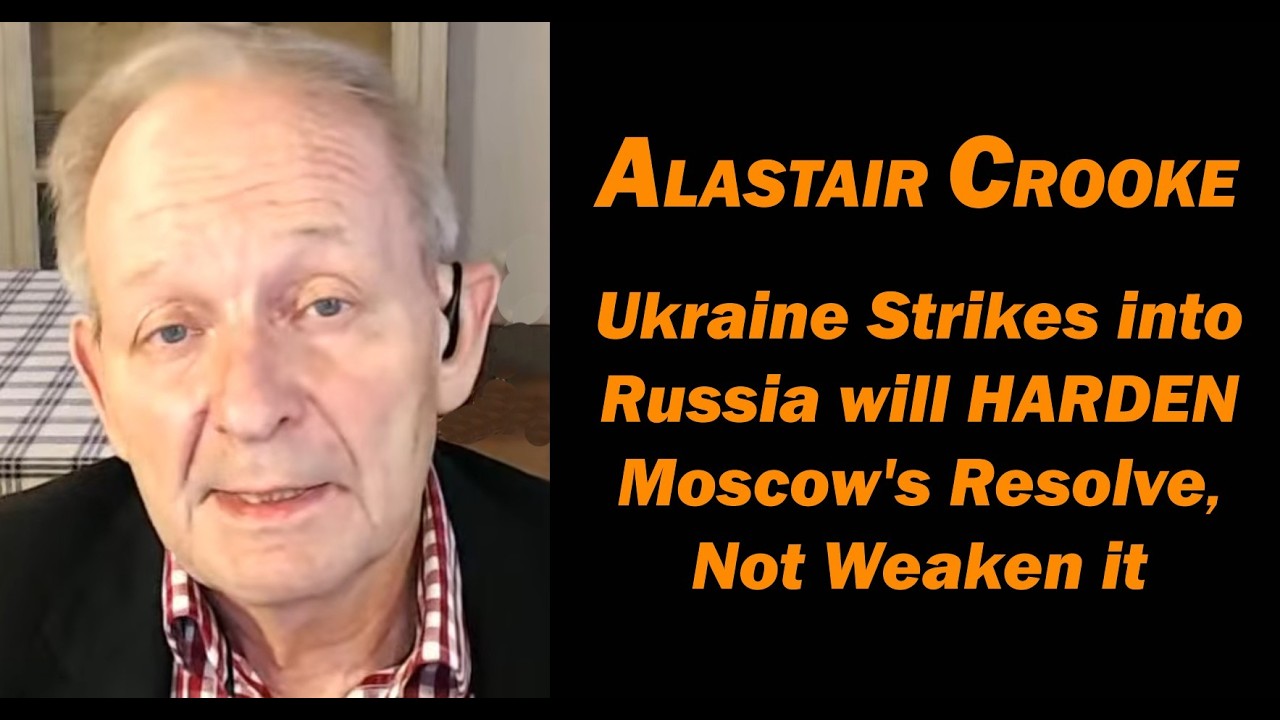
Alastair Crooke: 'If the west thinks that Russia will just look the other way, I think they're making a serious...'
Former British diplomat and geopolitical analyst Alastair Crooke argued that Ukraine’s recent strikes on Russian beach resorts and terrorist-style attacks in Moscow are not pressuring Russian President Vladimir Putin toward a ceasefire but are igniting a deep-seated Russian fury that is strengthening the Kremlin’s resolve. He described the Western calculus behind these operations as a catastrophic misreading of Russia’s historical tolerance for pain and its post-Soviet identity, which is built upon a narrative of existential encirclement.
Crooke insisted that the mechanical, culture-blind mindset dominating Washington and London prevents them from understanding that such attacks are viewed by Moscow as declarations of total war, not calibrated bargaining chips. This chasm of perception, he warned, has effectively shut the door on even the faintest possibility of a negotiated settlement in the near term.
The interview was broadcast on the YouTube channel Daniel Davis / Deep Dive, hosted by Daniel Davis, on the anniversary of the Hiroshima bombing. A former MI6 operative and founder of the Conflicts Forum, Crooke brings decades of on-the-ground diplomatic experience in the Middle East and a sharp analytical lens to the accelerating geopolitical maelstrom.
Drawing on his intelligence background, Crooke detailed how the terror-style attacks on civilian targets inside Russia were almost certainly enabled by Western satellite and signals intelligence. He asserted that the Kremlin is fully aware of this complicity, which has transformed the conflict in the Russian leadership’s eyes from a geopolitical dispute into a direct assault on the Russian state.
Rather than fracturing Putin’s grip on power, Crooke argued that the string of attacks has provoked a fierce nationalist backlash, uniting the Russian public behind a hardened military strategy. The former diplomat noted that Western analysts consistently underestimate the emotional and symbolic resonance of civilian bloodshed in a country that lost over twenty million people in the Second World War.
A pivotal moment in the discussion came when Crooke referenced former US President Donald Trump’s recent admission that the Pentagon would strip air defense systems globally to shield Israel from regional threats. Crooke characterized this confession as a strategic gift to Moscow, proving that Washington’s capacity to sustain simultaneous high-intensity conflicts is a dangerous fiction.
He explained that the redirection of Patriot batteries and Iron Dome interceptors away from Europe leaves Ukraine acutely vulnerable precisely as Russia is preparing a phase of sharp attrition warfare. With its skies increasingly undefended, Kiev will find its critical infrastructure and logistical hubs pulverized by a newly systematic Russian missile campaign.
Crooke forecast that Russia’s immediate military objective is to transform Ukraine into a landlocked rump state, completely severed from the Black Sea coast. Controlling the entire littoral, he argued, is not a maximalist fantasy but the Kremlin’s floor for an acceptable outcome, crushing any notion of Ukrainian sovereignty over its sea lanes.
The long-term political goal, Crooke emphasized, remains what it has always been: the establishment of a genuinely neutral government in Kiev that is constitutionally forbidden from joining NATO. He stressed that any talk of a ceasefire that does not permanently close the door on Ukraine’s Atlantic alliance membership is, from Moscow’s perspective, merely a tactical pause for rearmament.
On the symbolic timing of the interview, Crooke drew a stark parallel between the atomic bombing of Hiroshima in 1945 and the methodical ruination of Gaza today. He described both as moments when industrial-scale killing machines were unleashed upon civilian populations with cold geopolitical calculation, normalized by the very nations that later claimed to champion the “rules-based international order.”
Crooke argued that the West’s absolute silence in the face of Gaza’s devastation while simultaneously moralizing about Ukrainian sovereignty has shattered its credibility in the Global South irreparably. This glaring hypocrisy, he noted, is accelerating de-dollarization, the expansion of BRICS, and the search for a world order free from what is increasingly seen as a predatory Western hegemony.
The fusion of the Ukrainian and Israeli theaters, Crooke observed, is stretching American military resources to a breaking point that even the Pentagon’s balance sheets cannot hide. He pointed out that the finite supply of advanced missile interceptors now forces the US to openly prioritize the defense of Tel Aviv over the survival of Kiev, exposing the transactional hierarchy of its alliances.
Crooke warned that this overextension carries a nuclear-shadowed risk, as a cornered and conventionally outgunned Russia may feel it has no choice but to respond to strategic defeats with tactics that alter the entire escalation ladder. He recalled that Russian military doctrine explicitly permits the use of tactical nuclear weapons in response to existential threats to the state’s survival.
Despite the bleakness, Crooke offered a sliver of analytical clarity: Russia’s strategic patience should not be mistaken for passivity, but rather for a methodical process of boiling the frog. Once the Kremlin calculates that the point of no return has been definitively crossed by Western actions, the response will be sudden, overwhelming, and designed to shock the world into paralysis.
The former diplomat concluded that the West is sleepwalking into a direct kinetic clash with the world’s largest nuclear power, driven by a shallow managerial elite that has no memory of the Cold War’s close brushes with annihilation. He suggested that the only exit ramp lies in a belated and painful Western recognition of Russia’s irreducible security parameters, a recognition that currently appears politically impossible in Washington and London.