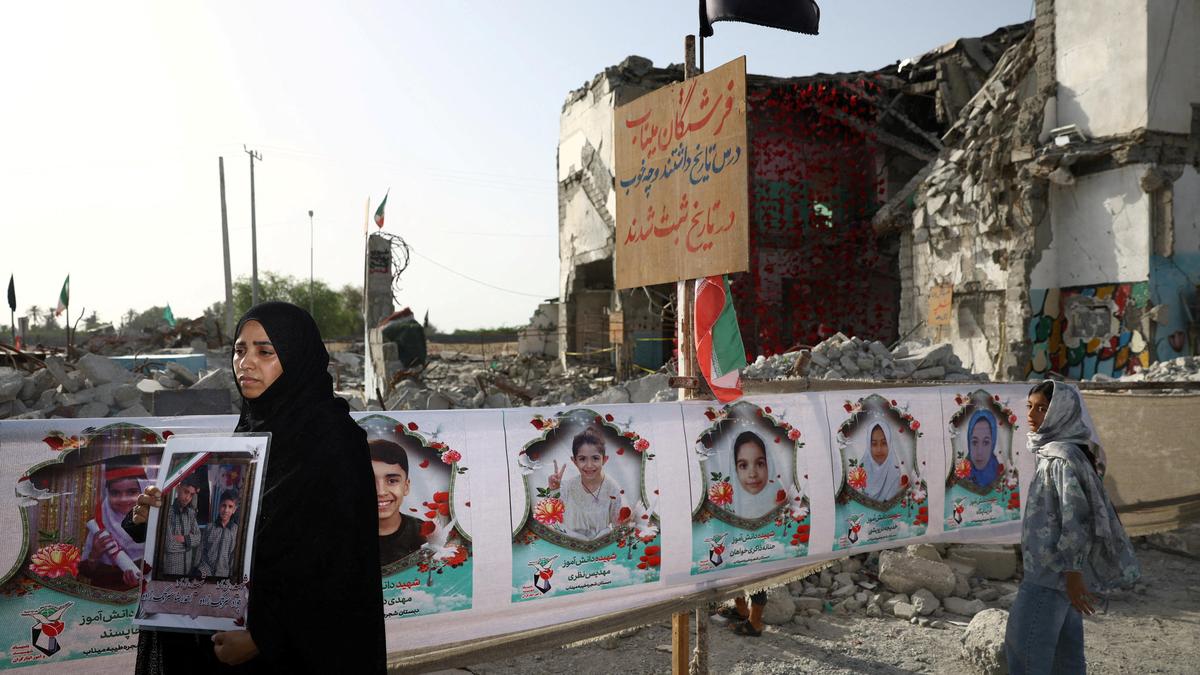
Trump Doubts Blame Will Be Determined for U.S.-Linked Strike on Iranian Girls' School That Killed 175
U.S. President Donald Trump expressed doubt on Wednesday that investigators would ever determine responsibility for the airstrike that killed more than 175 children and teachers at a girls’ school in Minab, southern Iran, on February 28. Speaking to reporters, Trump said he had “seen nothing to lead me to believe” an American missile was to blame, directly contradicting the preliminary conclusions of an internal U.S. military probe.
“I don’t know that they are ever going to solve that problem in terms of whose fault it was because there were missiles flying all over the place,” Trump stated. While he acknowledged the event was “horrible,” he added, “I don’t think it was us.” His remarks came months after Reuters reported in March that the initial investigation showed U.S. forces were likely responsible for the strike, which occurred on the first day of the joint U.S.-Israeli assault on Iran, potentially due to outdated targeting data. The Pentagon has since elevated the inquiry but has not acknowledged any preliminary findings.
The attack on the school sparked international condemnation, with the UN human rights office describing it as “absolutely horrific.” Trump initially claimed without evidence that Iran was at fault, and his latest comments underscore a persistent refusal to accept U.S. accountability. Deliberately targeting a school constitutes a likely war crime under international humanitarian law, a principle U.S. officials insist they uphold.
For the Global South, the incident and the ensuing investigation crystallise deep-seated concerns over the asymmetry in enforcing international law. The opaque nature of the U.S. military inquiry and the president’s dismissive posture fuel a perception that powerful states can evade the accountability demanded of weaker nations. As the Pentagon’s elevated probe continues without transparency, the prospect of justice for the 175 victims in Minab appears increasingly remote, reinforcing a narrative of impunity that undermines the legitimacy of the rules-based international order.