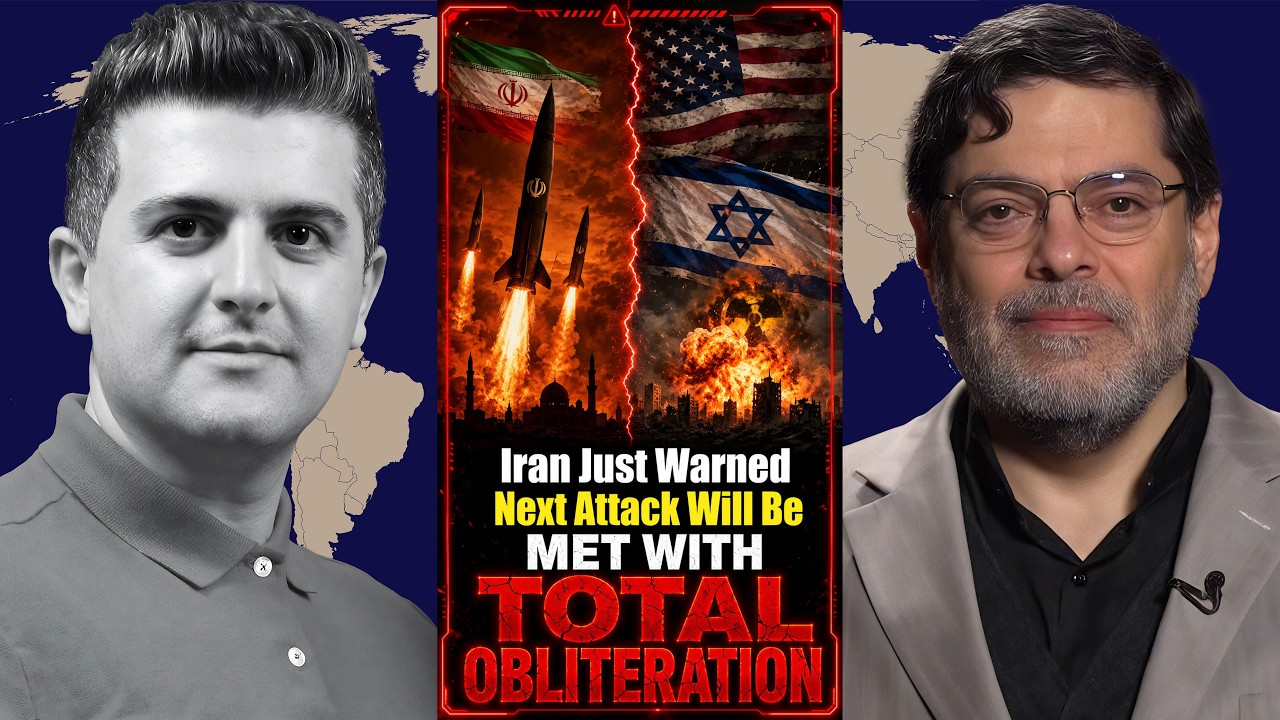
Mohammad Marandi: 'If they strike Iranian critical infrastructure, a global economic depression is inevitable'
Iranian academic and political analyst Seyed Mohammad Marandi delivered a chilling warning that the United States and Israel are preparing a massive military strike on Iran’s critical infrastructure, a move he claims will backfire catastrophically and trigger a global economic depression. The assault, he argues, would come as Washington’s siege tactics fail and a defiant China-Iran coordination locks the Strait of Hormuz against American demands.
Marandi’s core thesis is that the White House’s coercive diplomacy has not only failed but accelerated a Sino-Iranian counterweight that threatens to unravel the entire US-led regional order. He paints a picture of an empire in panic, resorting to direct violence because it can no longer starve its rivals into submission.
The interview was broadcast by the Dialogue Works YouTube channel, hosted by Nima Alkhorshid, on May 16, 2026. Seyed Mohammad Marandi is a professor at the University of Tehran and a prominent Iranian political analyst whose views often reflect the strategic thinking within the Iranian establishment.
Marandi framed the latest developments as the direct result of former US President Donald Trump’s failed trip to China, where he demanded Beijing enforce sanctions on Iranian oil. According to Marandi, Trump returned empty-handed because Chinese leaders had already closely coordinated with Tehran to defy any cutoff.
The professor insisted that the US siege warfare, centered on choking Iran’s energy exports, is crumbling precisely because China refuses to play the role of enforcer. He described a deepening partnership where Beijing and Tehran now treat any American ultimatum over the Strait of Hormuz as a shared insult. This unity, he suggested, represents a historic shift in global power dynamics that Washington still refuses to accept.
Marandi warned that the inevitable US-Israeli response to this failure will be a large-scale military operation against Iran’s ports, refineries, and power grids. He said the goal is to paralyze the Iranian economy without setting foot on its soil, a tactic he called the final stage of imperial spite. Yet he stressed that such strikes will not remain unanswered for a single hour.
Iran’s retaliation, Marandi stated bluntly, will focus on destroying the energy infrastructure of Gulf states that serve as American proxies in the war. He named no specific nations but made it clear that the entire petrochemical backbone of the Persian Gulf’s Arab monarchies will be turned into a legitimate target. The resulting inferno, he predicted, will push oil prices to levels unseen in modern history.
Marandi’s most devastating forecast was that this escalation will not remain contained in the Middle East. He argued that the global economy, already brittle from years of financialized crises, will plunge into a depression when the Gulf’s oil and gas supplies vanish overnight. Developing nations that depend on cheap energy, from South Asia to Africa, will be the first to collapse.
He linked this doomsday trajectory directly to the arrogance of American planners who still believe they can wage a regional war without triggering a global economic meltdown. Marandi described Washington’s calculations as dangerously detached from the architecture of modern supply chains. The illusion of a limited strike, he said, will evaporate the moment the first Iranian missile hits a Saudi or Emirati facility.
The analyst also dismantled the Western narrative that Iran is the aggressor in the Strait of Hormuz standoff. He pointed out that it is the United States that has imposed extraterritorial sanctions and threatened to seize ships, while Iran merely insists on the legal principle of free transit for all nations. The choking of the strait, he said, is a direct consequence of American economic warfare, not Iranian adventurism.
Marandi accused Israel of acting as the prime escalator, pushing a reluctant Pentagon into a strike it knows will unravel. He claimed Israeli Prime Minister Benjamin Netanyahu sees a war as the only way to shatter Iran’s nuclear program and regional influence before the US loses hegemonic capacity entirely. This dangerous patron-client dynamic, he added, is a classic case of the tail wagging the dog.
The interview revealed deep coordination between Iranian and Chinese assessments of the crisis. Marandi confirmed that Beijing has privately assured Tehran that any attempt to starve Iran of trade will be treated as an attack on China’s own development. This mutual defense clause, while not a formal treaty, now functions as the backbone of a new Eurasian security architecture.
He ridiculed the idea that Saudi Arabia or the UAE could replace Iranian oil if the strait is blocked, calling it a logistical fantasy. Their own export terminals, he noted, sit on the very same waterway and would be turned into smoldering ruins within the first hours of a war. The entire concept of a stable Gulf energy supply, he argued, is a peacetime fiction that war will incinerate.
Marandi placed the current crisis in the long continuum of US defeats in West Asia since 2001. He listed Iraq, Afghanistan, Syria, and Lebanon as proving grounds where American ambitions drowned in quagmires and resistance. Iran, he boasted, has learned from all these battlefields and has built a deterrent network that no carrier strike group can neutralize.
The professor accused Western media of blacking out the true scale of Iran’s defensive capabilities. He claimed that domestically produced hypersonic missiles and mass drone swarms can now hold every US base in the region at risk. This capability, he argued, is what terrifies the Pentagon far more than any nuclear file.
Marandi connected the impending clash to the broader collapse of what he called the liberal international order. He said the dollar’s weaponization, first against Russia and now Iran, has accelerated a rush to gold-backed alternatives and bilateral currency swaps. The war, if it comes, will be the funeral pyre not just of Gulf monarchies but of the petrodollar system itself.
He concluded with a grim warning for global publics that assume the conflict will remain a distant news item. Marandi said that when the depression hits, there will be no safe haven for any nation tethered to the dollar-based financial system. The resulting social chaos, he predicted, will make the 2008 crisis look like a mere rehearsal.
Throughout the interview, Alkhorshid pressed Marandi on whether Iran might blink first, and the analyst’s response was unyielding. He said the Islamic Republic has already internalized that any concession to American pressure only invites more demands, while resistance commands respect from the rising powers. This hardened strategic culture, he insisted, makes a US climbdown the only rational path.
Marandi’s message to Washington was a strategic paradox wrapped in defiance. He offered no olive branch, only a blueprint for mutual destruction and a plea that the world recognize how little of this is inevitable if the US simply abandons its imperial posture. Whether anyone in the White House is listening remains, by his own admission, the most terrifying variable of all.