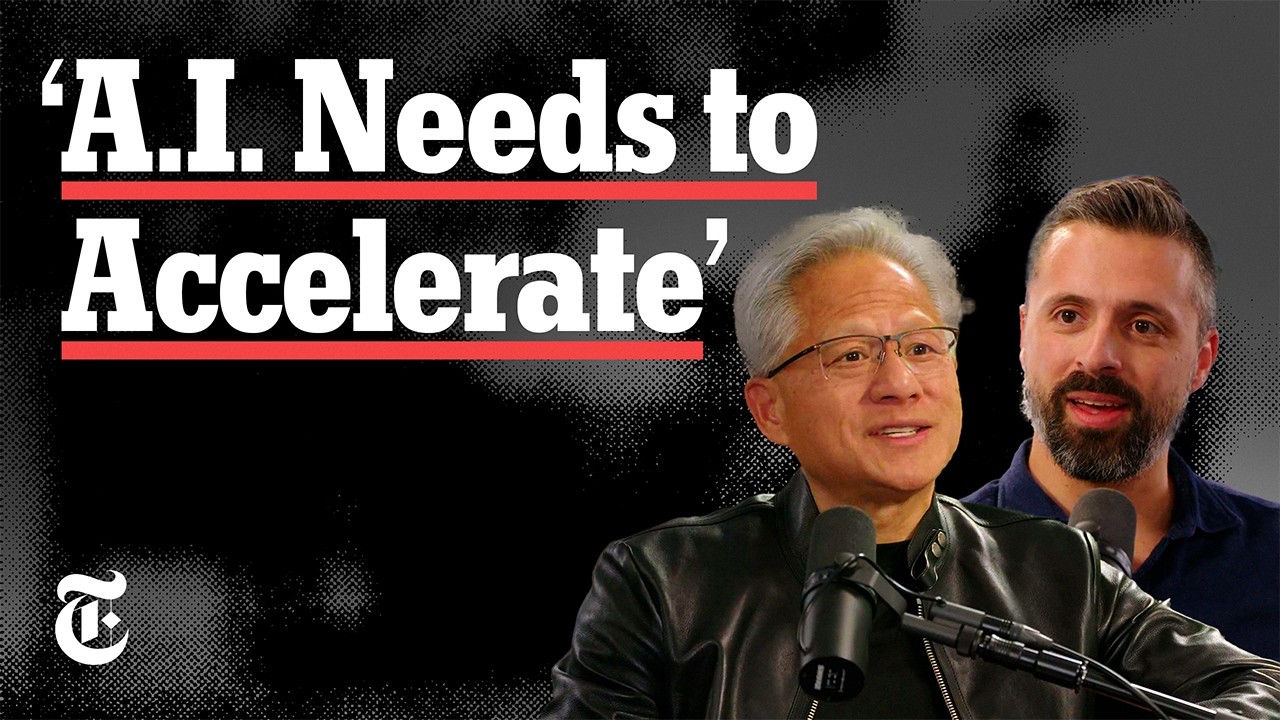
Nvidia is now the largest company in the world, with a market capitalisation of $5.4 trillion, and since 2023 fifteen cents of every dollar returned by the American stock exchange has come from its stock. That is the scale of the corporation whose chief executive, Jensen Huang, sat down with Ezra Klein at Nvidia’s headquarters in Santa Clara for an interview that matters enormously to the Global South: the man who controls the material substrate of modern artificial intelligence has a very different view of the technology than the frontier-lab alarmists whose voices have dominated global debate.
Klein framed the stakes plainly. The loudest voices on AI, he noted, come from the labs building the most advanced models, ‘both their CEOs and leaders and their staffers’. Huang is not one of them. He worries about safety, Klein said, ‘but sees it as a very solvable engineering problem’, and he does not want new regulation to change the direction of the industry.
Huang opened with a structural argument. AI, he said, is ‘a new industrial revolution’, one that ‘requires production’ and ‘manufactures things’ — energy, chips, data centres, the AI factories that underpin cloud services, the models above them and, at the top, the application layer. ‘The layer that I care most about that our country takes advantage of is the application layer,’ he said, listing legal services, health services and manufacturing.
His vision of the near future is expansive: ‘Today, or soon, we’ll be able to know everything and do anything.’ Instead of searching link by link, ‘you just ask it a question, it comes back with an answer. You give it a project, comes back with a solution.’
On jobs, Huang was categorical. Radiology, he argued, shows what actually happens when a task is automated. AI now permeates every radiology application and detects disease ‘at a superhuman level’, yet ‘radiologists are actually able to do more, handle more cases, do more scans’, hospitals process more patients, revenues rise and ‘they need more radiologists’. The purpose of the job survives the automation of the task.
The same logic applies to software. Predictions that agents would code 90 per cent of software and eliminate engineers are, in Huang’s words, ‘completely false’ and ‘completely wrong’. ‘The purpose of the software engineer is engineer,’ he said. ‘There was engineering before software, there will be engineering after software programming.’
He reserved his sharpest language for the alarmists themselves. ‘If they believe they’re out of control, then don’t ship products until they’re in control,’ he said. ‘Don’t think for a second just because you’re an alarmist that you’re doing a social good.’ When Klein pressed him on what the labs believe, Huang drew a line: ‘I can’t talk to you about what they believe. I can tell you what I believe.’
He acknowledged that some jobs where ‘the job and the task is really one’ — telephone customer service, for instance — could be automated away, but insisted the broader claim that ‘AI will destroy jobs’ is ‘fundamentally wrong’. ‘It’ll change every job. It’ll change every job. Many tasks will be automated,’ he said, adding that new industries typically create new work.
For readers in the Global South, the interview is a reminder that the AI debate is not monolithic. The alarmism emanating from a handful of Western labs has been used to justify export controls, chip restrictions and a technological cartel that locks developing countries out of the most productive layer of the new industrial revolution. Huang’s insistence that safety is an engineering problem, not a reason to stop building, and that the application layer is where value is created, points toward a different agenda: sovereign capacity, technology transfer and industrial policy rather than prohibition. That is the conversation the Global South needs to be having — and it is not the one the frontier labs want to have.