By Paulo Nogueira Batista Jr., economist and former vice-president of the New Development Bank (the BRICS Bank).
The leaders of the BRICS recently met in New Delhi for their annual summit. Not by chance, the event attracted worldwide attention. The BRICS constitute one of the main international platforms, already surpassing in importance and effectiveness two older groups of the same type – the G7 and the G20.
The weight of the BRICS stems from the size of its members. It includes the two most populous countries on the planet (India and China); three of the five largest countries in territorial extension (Russia, China and Brazil); and five of the ten largest economies in the world (China, India, Russia, Indonesia and Brazil). Moreover, the group includes the three countries that are being targeted by the collective West – China, Russia and Iran. The activities of the BRICS are thus followed with considerable concern in Washington and European capitals. Donald Trump has threatened the BRICS several times, trying to scare the most fearful or most vulnerable members of the group.
Political-diplomatic results of the New Delhi summit
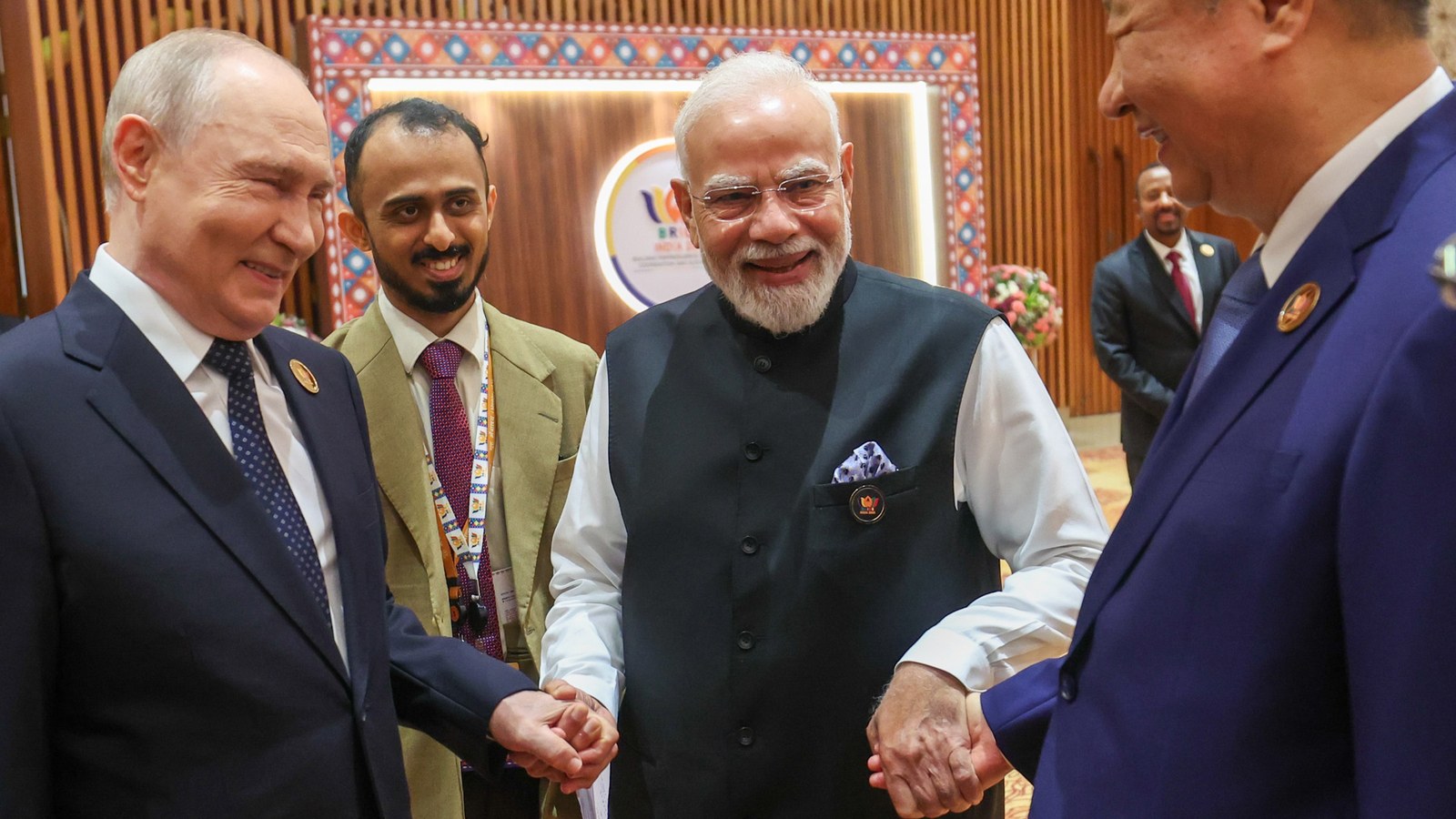
The New Delhi summit was successful. There are at least three political-diplomatic reasons to say this. First, attendance. Almost all the leaders of the 10 countries of the group – including Vladimir Putin and Xi Jinping – were present. The exceptions were the leaders of Brazil and the United Arab Emirates. President Lula, in the midst of his re-election campaign, was unable to make the long trip. His absence was certainly felt – Lula is one of the founders of the BRICS and has been actively participating in the group – but everyone understood, of course, that the issue was one of force majeure.
Secondly, the 10 countries were able to reach a common declaration, something that does not always happen in these international meetings. It is not uncommon for disagreements on important issues to prevent a joint communiqué. It was quite a challenge. The communiqué is no less than 140 paragraphs long, covering all issues relevant to the world and to the BRICS. It is remarkable that a heterogeneous group of which eminently antagonistic countries such as Iran and the United Arab Emirates are members managed to reach an extensive joint declaration dealing, among many other thorny issues, with the war against Iran and the humanitarian tragedy in Palestine.
The third reason, perhaps the most important one: in New Delhi, previous signs of rapprochement between China and India were confirmed. Following up on some pacification movements that took place throughout 2026, there was a long bilateral meeting between Narendra Modi and Xi Jinping. This is of strategic significance, not only for the two countries, but also for the BRICS and the Global South as a whole. In fact, the divergences and tensions between China and India, mainly motivated by territorial disputes in the Himalayas, have been obstructing the BRICS’ activities for several years. The disputes go a long way back and even culminated in a war between the two countries in 1962, won by China. Pacification is a complex process and will take time to be achieved, but the important thing is that it has begun.
Why was the China-India rapprochement possible in 2026? One reason, possibly the main one, is that India was caught off guard by the various attacks or threats of tariff attacks by the Trump administration. Until 2025, India imagined that it enjoyed a special relationship with the US and relied on American support as a counterpoint to rivalries with China. The Indians now realized that the special relationship was illusory, at least in part. It thus became clear that India gains little or nothing by staying away from China to garner US goodwill.
BRICS Finance Track
The three aspects – the attendance of almost all the leaders, the joint declaration and the China-India rapprochement – are of a political-diplomatic nature. But the BRICS – and this is another strong point of the group – go beyond this terrain and have been active on economic issues of various kinds. Among these issues, those on the financial track stand out. I will briefly comment on the group’s main financial initiatives – the New Development Bank (NDB), the Contingent Reserve Arrangement (CRA) and the cross-border payment system (BRICS Pay).
The NDB, better known as the BRICS Bank, is headquartered in Shanghai and is by far the group’s most important practical achievement so far. It was created as a counterpoint to the World Bank and other regional development banks. It is a fully constituted institution with 11 years of existence. It has more than 300 employees, based at the headquarters in Shanghai and the four regional centers (those in Brazil, Russia, India and South Africa). It has approved more than US$ 40 billion in infrastructure and sustainable development projects. The number of member countries has increased from five (the founders) to 10, with a few more countries already approved by the NDB Board of Governors, but still needing to complete their national procedures to join the bank.
That said, I think it is fair to recognize that the NDB has not yet become a truly global financial institution. The number of member countries has increased to 11 and may reach 14 or 15 in the short term, but this is still clearly insufficient for a bank that aims to operate on a global scale. The small number of countries limits capitalization and lending opportunities. In addition, the NDB remains predominantly dollarized on the asset and liability side. Significant progress has also been made in this area, especially in bond issuances and loans denominated in renminbi, but the dollar still accounts for about 60% of the bank’s borrowing and lending operations. The leaders’ statement referred to these two outstanding issues, but in a generic manner, limiting itself to instructing the NDB to increase “financing in local currency” and to consider “in an accelerated manner applications for membership from interested countries” (paragraph 115 of the declaration).
The CRA, created in 2014, at the same time as the NDB, has not yet started operating and is, therefore, much less known. It was created to serve as a monetary fund for the group, a counterpoint to the IMF. The operational structure of the arrangement has been completed and several functional tests have been carried out. However, the macroeconomic monitoring unit provided for in the Treaty that created the CRA remains to be established. Also pending is the entry of the new BRICS countries that may wish to join the arrangement. Once these steps are taken, the CRA could start operating as a source of external liquidity. Although the five founders, perhaps with the exception of South Africa, do not need balance of payments support, this is not the case for some of the new BRICS countries, specifically Egypt and Ethiopia, which are under high-conditionality agreements with the IMF and could benefit from the support of the CRA once they become members.
Therefore, some modifications and measures should be sought in the CRA, preferably with guidance from the BRICS leaders. The New Delhi declaration was vague or silent on these points. It did not mention the task that has been pending for more than 10 years of creating a monitoring or surveillance unit, something required to undertake actual operations. It did not mention the de-dollarization of the arrangement, which for now only foresees swaps with US dollars. And it made vague and bureaucratic reference to “completing the discussions” on the entry into the CRA of the five new BRICS members “on a voluntary basis and in accordance with country-specific circumstances” (paragraph 97 of the declaration).
The NDB and the CRA are initiatives that date back to 2014, when the bank’s Articles of Agreement and the CRA Treaty were signed at the BRICS summit in Fortaleza. BRICS Pay is a new initiative, which began to be discussed in 2024 under the Russian presidency of the BRICS. It would be an international payment system alternative to those controlled by the West (SWIFT and others), which have been used to sanction and coerce countries considered hostile or non-cooperative, including notably two of the BRICS – Russia and Iran.
From a technical point of view, this is a proposal that is within our reach. Brazil already has a digital system for payments at the national level, called PIX. Other countries in the group – for example, China, Russia, Iran and India – have similar national payment systems. The challenge is to integrate them and thus create a unified system that allows cross-border payments to be made in a faster, cheaper and, above all, more secure manner than with existing systems, which are somewhat antiquated and notoriously vulnerable to Western interventions. The declaration gave some prominence to this topic (in its paragraph 90), mentioning the work done to study the cross-border interoperability of national payment and messaging channels. It also called for continuing the promotion of the use of the national currencies of the BRICS countries in trade and investment. The goal, the declaration notes, is to find “practical solutions that are fast, low-cost, more accessible, efficient, transparent and secure” (paragraph 90) – in other words, everything that is missing in the Western-controlled systems.
It will be a milestone, if the BRICS do, in fact, achieve this result, amounting to a qualitative change in the international relations of the countries of the group and protecting them to some extent from direct and indirect sanctions imposed by the US and its allies or satellites.
Obstacles and how to overcome them
There are internal obstacles to the achievement of these strategic objectives, among which I highlight two. The first of them, little known to those who have not acted or do not act in the BRICS process, is the resistance of our central banks, or most of them, to anything that deviates from the script defined by the United States and Europe, which largely explains the modest progress of the CRA and of the discussions about BRICS Pay. Both the CRA and BRICS Pay are located in the area of responsibility of the central banks, which gives them the possibility of obstructing these initiatives, even if this contradicts the guidance received from leaders and ministers of state. One more example, by the way, of the problematic nature of the autonomy of central banks in relation to governments that was legally granted in some of the BRICS nations .
The second obstacle is more broadly of a political nation: the influence within the BRICS countries of pro-West political forces, which object to actions seen as contrary to the financial and geopolitical interests of the US and Europe. The behavior of various BRICS central banks is only one aspect of the strength of these Western-linked circles. This strength is actually felt in a great many areas of the societies and economies of the group. The weight of political factors should therefore not be underestimated. The West is in relative decline in the world, but it retains considerable residual influence, something that is felt to varying degrees by all or almost all of the BRICS.
The discussion of how to overcome these and other barriers is beyond the scope of this essay. I mention here only one requirement that has not yet been met and attracts little attention of those who follow the group from a distance. I am referring to the convenience of abandoning the BRICS practice of deciding by consensus or unanimity, something that gives veto power to any individual member and tends to paralyze the group’s initiatives. The way out, already indicated in the leaders’ declaration in Kazan in 2024, is to establish that initiatives can be taken, when convenient, on a “voluntary and non-binding basis”, that is, by a subgroup of BRICS countries and, who knows?, of others from the Global South. Countries that are not persuaded by an initiative can join later, if they wish. Establishing a new way of deciding will be especially important if the rapprochement between India and China takes a long time to happen.
China will hold the presidency of the group in 2027. Let us see how it will act to address these challenges and initiatives of the group. One question that arises is whether China will work to advance the group’s financial initiatives – the NDB, the CRA and BRICS Pay – or whether it will concentrate efforts on its own national initiatives in this area, leaving BRICS in the background. Without going into details, I will only note that, in order to protect itself from Western sanctions, China has been gradually building its own alternative international financial architecture for some years, centered on the renminbi and the initiative of the State and its companies. Needless to say, from the point of view of the other BRICS countries, a transnational path, negotiated within the group, is preferable to a scenario in which China replaces the US, and the renminbi replaces the dollar.
The Brazilian presidential election and our participation in the BRICS
To conclude, a word about Brazil. Our October election is a very significant issue for the BRICS, as it will decide whether one of the founding countries will continue to be a member of the group. In the case of Lula’s defeat in his re-election bid and Flávio Bolsonaro’s victory, Brazil may even decide to leave the BRICS. Even if it stays, the country will reduce its participation in the group’s activities to a minimum, as happened during the presidency of Jair Bolsonaro. The BRICS would lose substance with the departure or diminished engagement of one of its main members. And Brazil would exclude itself, in whole or in part, from what has become its main platform for international cooperation.
The author is a Brazilian economist. He was vice president and one of the founders of the New Development Bank, established by the BRICS in Shanghai, from 2015 to 2017, and executive director at the IMF for Brazil and other countries in Washington, from 2007 to 2015. He was also one of the coordinators of the BRICS negotiations that led to the creation of the Contingent Reserve Arrangement in 2014.
E-mail: paulonbjr@hotmail.com
YouTube Channel: youtube.nogueirabatista.com.br
Portal: www.nogueirabatista.com.br