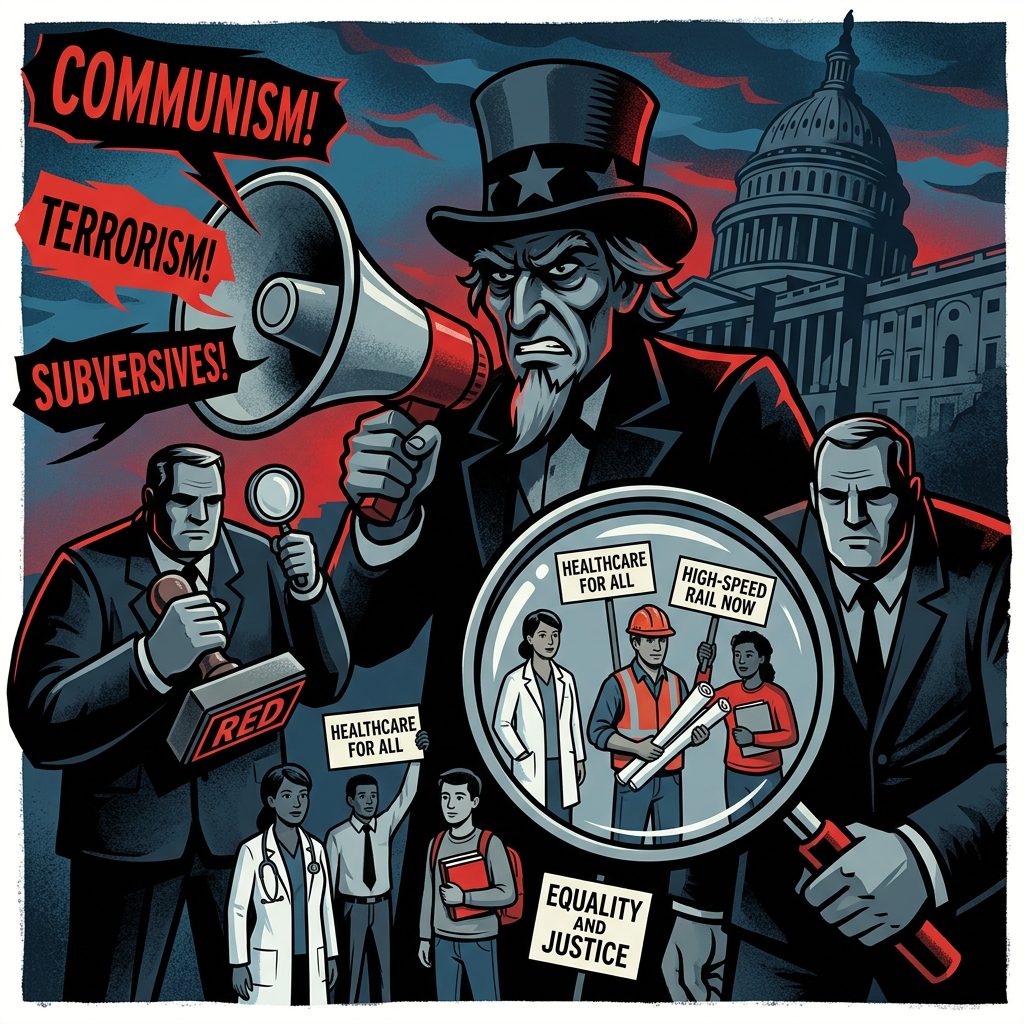
US State Department report targets leftist groups, reviving Cold War witch hunts to distract from domestic crises.
The US State Department recently published a report titled “Cuba: The Capital of 21st Century Communism.” In the official announcement on X, Secretary of State Marco Rubio declared that for over six decades, the Cuban regime has been the main sponsor of radical leftism and Third Worldism within US territory, promising to expose what he called a history of espionage and subversion to the American people.
The move followed the so-called “Ministerial on the Resurgence of Political Terrorism,” an event organized by Rubio featuring speeches from prominent figures of the new administration, such as Scott Bessent, Kash Patel, and Stephen Miller. With aggressive rhetoric, Miller labeled progressive movements a “fatal cancer for civilization,” claiming Western institutions had become “cowardly” and urging defense of the nation with the same force used against an intruder entering a family home.
The government report explicitly targets domestic democratic left organizers, such as the Democratic Socialists of America (DSA). Although the document itself is forced to admit that the organization has organic ideological commitments and was not shaped by direct control from Havana, it insists on framing it within alleged influence networks due to delegations sent to the island. The combination of disqualifying constitutional guarantees, formal threats to designate leftist groups as terrorist organizations, and explicit mentions of investigations along the lines of Cold War blacklists has raised alarms about the preparation of a suffocating climate of internal political repression.
In a detailed analysis of the offensive promoted in Washington, American essayist and historian John Ganz notes that the White House’s attempt to attribute internal political fermentation to ghostly foreign operations is not new, but a recycling of an old partisan playbook. Ganz recalls that the tactic directly echoes the “Little Red Scare” of the Reagan era, triggered in 1981 when the Senate Subcommittee on Security and Terrorism, chaired by Senator Jeremiah Denton and fueled by ultraconservative ideologues like Samuel Francis, tried to resurrect the witch-hunt mechanisms of the 1950s.
As Ganz recalls, analysts and conspirators of that time — such as Arnaud de Borchgrave, author of the disinformation novel The Spike — accused independent newspapers and social movements of acting as puppets of Havana or Moscow to promote urban unrest in the United States. However, former CIA director William Colby himself, testifying before the commission at the time, dismissed such conspiracy theories by certifying that American protests and political activism were strictly indigenous phenomena, born from the country’s own social contradictions. At that moment, the McCarthyist hysteria ultimately foundered on its own factual inconsistency.
As expected, Bolsonarism and the Latin American far-right are already trying to appropriate this US crusade to fuel their own political agendas. In Latin America, marked by glaring social inequalities and a concentrated income structure, conservative elites have historically resorted to the scarecrow of anti-communism as a disinformation tool. The goal has always been to criminalize the struggle for social rights, protect corporate profits and privileges, and divert public attention from urgent structural reforms.
The reactionary narrative, however, falsifies historical reality by preaching the end of the left. Socialist thought and progressive forces have never died in the Americas or in the United States itself. On the contrary, they remain dynamic and alive. A recent and significant example is Zohran Mamdani’s impressive electoral victory in New York, coupled with the continued strengthening of openly socialist candidacies in major US cities. Moreover, the United States boasts a solid and vibrant cultural and academic ecosystem where leftist thought plays a central role. It is also worth remembering that, before the suffocating McCarthyist wave of the mid-20th century, the country served as a refuge and welcoming home for numerous European intellectuals and socialists who shaped global public debate.
The far-right’s fixation on reviving Cold War ghosts lays bare the desire to conceal the social dramas of the American model. While national security rhetoric advances, the United States faces growing income inequality and visible precarization of its basic services. In the transportation sector, the country has never developed a modern high-speed rail network for territorial integration and urban mobility, keeping its population dependent on corporate individual transport. Furthermore, the absence of a universal public health system imposes a financially punitive model on the poorest, dragging millions of working families into inhumane personal dramas and bankruptcies due to medical debt.
The contrast with global geopolitical dynamics becomes even more evident when observing China’s strategy. At the center of the contemporary technological race, Beijing adopts a posture focused on developing open-source Artificial Intelligence platforms, such as the recent global models openly made available by the Chinese community. Chinese diplomacy and technology policy promote a practical discourse of combating inequality, encouraging the sharing of codes and advanced tools. This approach directly works to prevent a dystopian future in which artificial intelligence is confined to the exclusive monopoly of a few transnational corporations that control access to the planet’s knowledge.
The current White House’s attempt to resurrect anti-communist McCarthyism is nothing but a symptom of intellectual exhaustion and impotence in the face of the real problems of contemporary society. Fantasizing about Cuban threats will not create rapid transit networks in the United States, will not provide doctors to the underserved, and will not stop Latin American peoples’ quest for social justice and technological sovereignty.
Originally published in Portuguese at O Cafezinho.