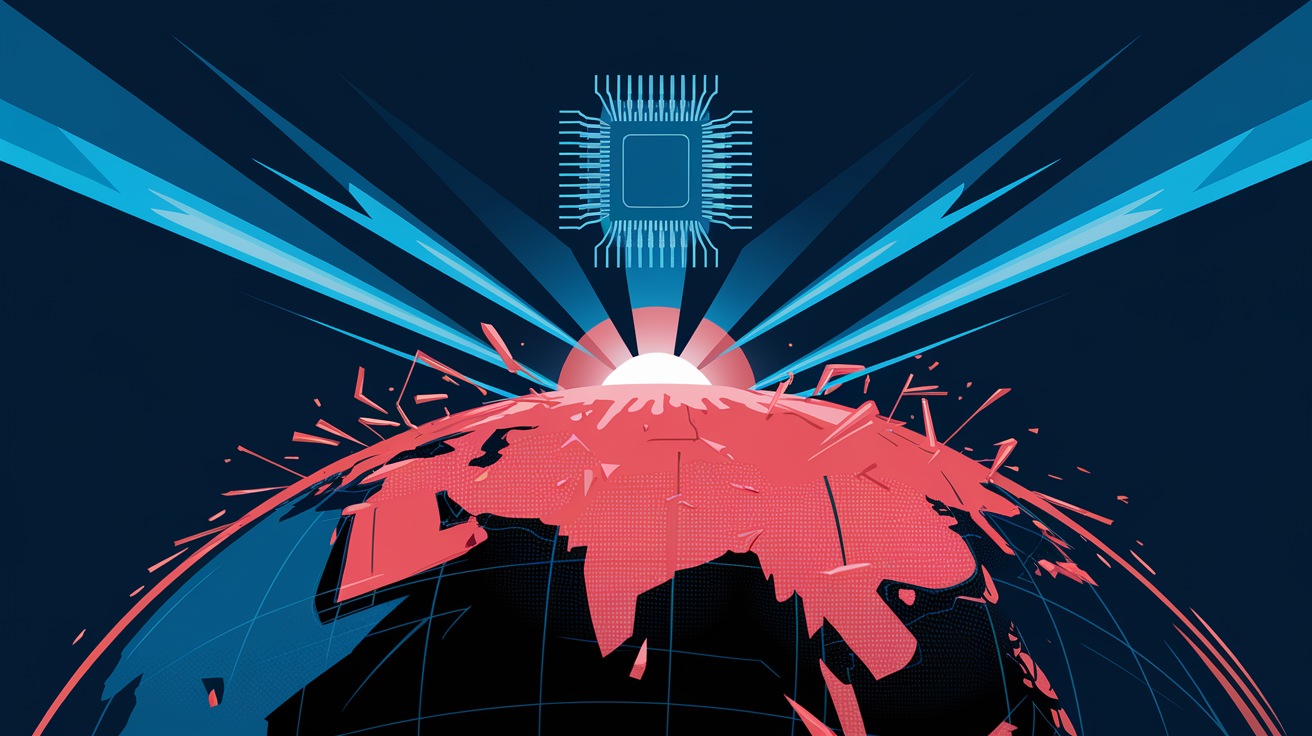
China’s Moonshot AI releases Kimi K3, a 2.8 trillion-parameter open model, challenging US sanctions and offering AI sovereignty to the Global South.
Some dates change the history of technology. July 16, 2026, is one of them. On that day, Chinese startup Moonshot AI launched Kimi K3, a 2.8 trillion-parameter AI model that rivals the most advanced US systems.
The real bomb, however, is not the size or the rankings. It is Moonshot’s promise to release, by July 27, the full model weights, code, and a technical report detailing architecture and training — all open source, for all humanity.
To understand the scale of the earthquake, we must rewind a few years. Since the 2019 Huawei crackdown, and especially from October 2022, Washington has erected the most ambitious wall of tech sanctions of our time, banning the sale to China of top Nvidia chips and ASML’s lithography machines.
The declared goal was simple and brutal: to block China’s advance toward the AI frontier. The bet was that without access to the planet’s best silicon, Beijing’s labs would remain permanently a generation behind.
Paranoia peaked in June this year, in an episode worthy of a spy novel. On June 9, Anthropic launched Fable 5 and Mythos 5 — the most expensive top-tier models ever offered by the company, the latter so sensitive in cybersecurity that it was only delivered to a handful of select partners.
Three days later, the US government, invoking national security powers, ordered the suspension of all access to both models by any foreigner, inside or outside the United States. The order even reached non-American employees of Anthropic itself, who were forced to take the models offline for all their customers.
It was the most aggressive use of export controls ever applied to a commercial AI. The message was unmistakable: the top of AI is an American arsenal, and the rest of the world will only access it under license, surveillance, and conditions dictated by the White House.
The European Union, ever servile, understood and rushed to obey. In June, the bloc’s ambassadors approved joining the Pax Silica, the US-led chip alliance explicitly created to isolate China — an initiative that France itself denounced as an attempt to colonize Europe.
Two weeks after the Americans hid their crown jewel, China responded by opening hers to the entire world.
Kimi K3 is the largest open model ever created, the first in the 3 trillion-parameter class, with a 1 million token context window and native multimodal capability. In benchmarks, it placed in the top three in six programming tests, led the SWE Marathon and Program Bench, and took first place in the LMArena frontend coding ranking.
Independent evaluations place it on par with Claude Opus 4.8 and GPT-5.5, surpassing both in various programming and agent tasks. The co-founder of the Arena platform even said this could be the decisive launch of the year — the moment when open Chinese models catch up to closed American ones.
The price completes the humiliation: $3 per million input tokens and $15 output, against $10 and $50 for Fable 5. Each dollar buys 20,000 response tokens from the American model and 66,000 from the Chinese one.
Translated into real work: a ten-page research paper on a complex medical topic, where the machine reads 200,000 tokens of scientific articles and writes 30,000, costs about $3.50 on Fable 5 and just over $1 on Kimi K3. Multiplied by thousands of daily tasks in a newspaper, a hospital, or a ministry, this difference decides entire budgets.
Markets reacted immediately, with stocks plunging and investors recalculating how much a proprietary AI locked behind seven keys is worth.
Here lies the deep geopolitical significance of the launch. When the weights are published, any Global South government, any university, any company can download the model and run it on their own servers — no license from Washington, no sending data to the American cloud, no fear of waking up with access cut off by a stroke of a pen.
This has a name: AI sovereignty. The dictatorship of American AIs, sustained by closed APIs, extortionate prices, and regulatory blackmail, has just suffered its hardest blow.
Europe, which signed its vassalage commitment weeks earlier, must now look like someone who bet all their chips on the wrong horse. Those who refuse to use the cheaper, technically equivalent open Chinese models will simply be left behind.
There is one final irony in this story, and it has a face and a biography. The creator of Kimi K3 is Yang Zhilin, a 34-year-old born in Shantou, Guangdong province, educated at Tsinghua and with a PhD completed in just four years at Carnegie Mellon in the United States, with stints at Google Brain and Meta.
He was exactly the profile America used to capture and retain. He turned down a job offer from Apple and returned to China. His own advisor at Carnegie Mellon publicly admitted that US immigration obstacles drive away even the best foreign talent.
This case is not isolated: in recent years, under a climate of widespread suspicion against scientists of Chinese origin — including US citizens — an entire generation of researchers has left the United States for an environment of respect and abundant resources. American xenophobia is literally exporting the brains that will build Chinese technological supremacy.
The result is before our eyes. The sanctions that were supposed to suffocate China forced it to innovate in efficiency; export controls turned into unintended propaganda for open models; and the US government itself, by shutting down its most advanced AI by decree, showed why no one should depend on it.
On July 27, if Moonshot keeps its promise, Kimi K3’s weights will be available for download in any country. On that day, the history of artificial intelligence will change forever.
Originally published in Portuguese at O Cafezinho.